News Citation : 2026 LN (HC) 380
June 16, 2026 : The Chhattisgarh High Court has dismissed a petition challenging an order passed under Section 14 of the Securitisation and Reconstruction of Financial Assets and Enforcement of Security Interest Act, 2002 (SARFAESI Act), reiterating that parties aggrieved by measures taken under the Act must ordinarily avail the statutory remedy before the Debt Recovery Tribunal (DRT).
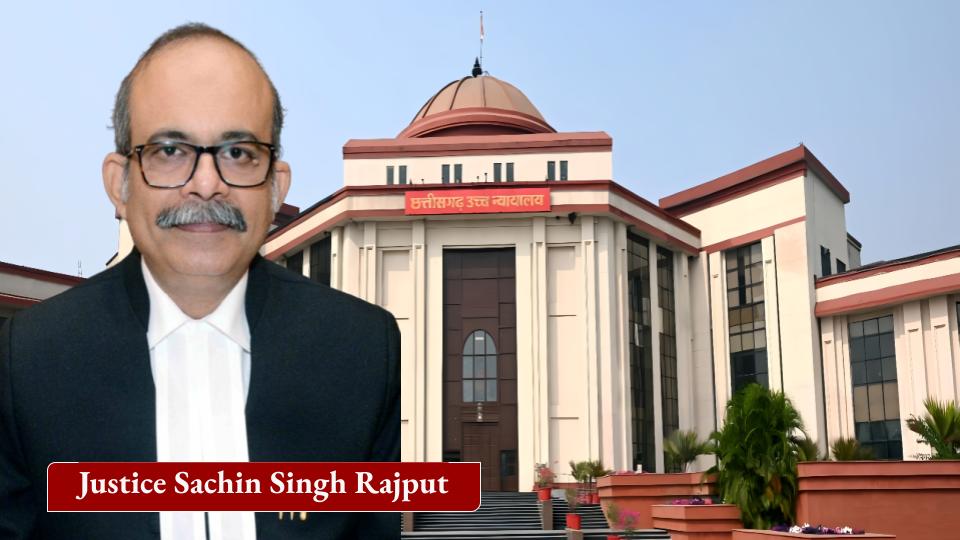
Justice Sachin Singh Rajput delivered the judgment in a petition filed by Ravindra Saraf, who had challenged an order dated December 3, 2025, passed by the Additional Chief Judicial Magistrate (ACJM), Raipur. The ACJM had allowed an application filed by Union Bank of India under Section 14 of the SARFAESI Act for taking possession of secured assets in connection with a loan default.
The dispute centered around land situated in Village Pangaon in Balodabazar-Bhatapara district. The petitioner claimed that the property formed part of ancestral or jointly held assets and that a civil suit regarding ownership, title, and share in the property had already been instituted in December 2024. According to the petitioner, the borrowers had allegedly mortgaged the property to secure financial assistance from the bank despite the existence of title disputes. He argued that the property did not possess a clear title and therefore could not form the basis of a valid security interest under the SARFAESI Act.
The petitioner further contended that the alleged mortgage was created through the deposit of title deeds, commonly referred to as an equitable mortgage. He argued that such a mortgage was not legally recognized in Chhattisgarh without a registered mortgage deed and therefore no valid security interest existed in favour of the bank. On that basis, it was argued that the bank could not invoke provisions of the SARFAESI Act, particularly Section 14, which empowers a Magistrate to assist secured creditors in obtaining possession of secured assets.
Another important challenge raised before the High Court related to territorial jurisdiction. The petitioner asserted that the ACJM at Raipur lacked jurisdiction because the property was situated in Balodabazar-Bhatapara district. According to him, the Magistrate had exceeded his authority by entertaining the bank’s application and authorizing possession proceedings concerning land located outside his territorial limits.
Opposing the petition, Union Bank of India raised a preliminary objection regarding maintainability. The bank argued that the SARFAESI Act itself provides a complete statutory mechanism for redressal through Section 17, under which any person aggrieved by measures adopted by a secured creditor can approach the DRT. The bank also informed the Court that the borrowers had already challenged the possession proceedings before the DRT, Jabalpur. It further maintained that the mortgage created through deposit of title deeds constituted a valid security interest under the Act and that possession and auction proceedings had already progressed substantially.
While examining the matter, the High Court relied extensively on Supreme Court precedents emphasizing judicial restraint in SARFAESI matters. The Court referred to decisions including United Bank of India v. Satyawati Tandon, PHR Invent Educational Society v. UCO Bank, Authorized Officer, State Bank of Travancore v. Mathew K.C., and Standard Chartered Bank v. V. Noble Kumar. These judgments consistently hold that High Courts should ordinarily decline to exercise writ jurisdiction when an effective statutory remedy exists under the SARFAESI framework.
Quoting the Supreme Court’s observations in Satyawati Tandon, the High Court noted: “It is a matter of serious concern that despite repeated pronouncement of this Court, the High Courts continue to ignore the availability of statutory remedies under the DRT Act and SARFAESI Act and exercise jurisdiction under Article 226 for passing orders which have serious adverse impact on the right of banks and other financial institutions to recover their dues.”
The Court rejected the petitioner’s attempt to invoke Article 227 of the Constitution on the ground that the impugned order allegedly suffered from jurisdictional defects. It held that all issues raised by the petitioner, including the validity of the mortgage, existence of security interest, pending civil litigation, and title disputes, could appropriately be examined by the DRT under Section 17 of the SARFAESI Act.
Addressing the question of locus standi, the Court observed that although the petitioner was not a borrower in the loan transaction, he could still seek recourse before the DRT. Relying on the Supreme Court’s decision in Jagdish Singh v. Heeralal, the Court held that the expression “any person” under Section 17 of the SARFAESI Act is broad enough to include persons whose rights may be affected by enforcement measures taken by secured creditors.
On the issue of territorial jurisdiction, the Court also declined to accept the petitioner’s argument. It observed that Section 14 permits the competent Magistrate to entertain applications where the secured asset or related documents are situated or found. Since the bank asserted that the loan had been sanctioned from Raipur and relevant documents were executed within that jurisdiction, the Court found no reason to interfere at the writ stage.
Ultimately, the High Court dismissed the writ petition while granting liberty to the petitioner to approach the Debt Recovery Tribunal under Section 17 of the SARFAESI Act. The Court clarified that if such an application is filed, the DRT must decide the matter independently and in accordance with law, without being influenced by any observations made in the High Court’s order.
The ruling reinforces a well-settled principle governing SARFAESI litigation: disputes relating to possession of secured assets, validity of security interests, mortgage transactions, and recovery proceedings should ordinarily be adjudicated by specialized tribunals rather than through writ proceedings. The judgment is likely to serve as an important precedent for borrowers, guarantors, co-owners, and third parties seeking to challenge SARFAESI actions, emphasizing that the DRT remains the primary forum for such disputes.
Case Reference:Ravindra Saraf v. Rajlaxmi Saraf & Others, WP227 No. 87 of 2026