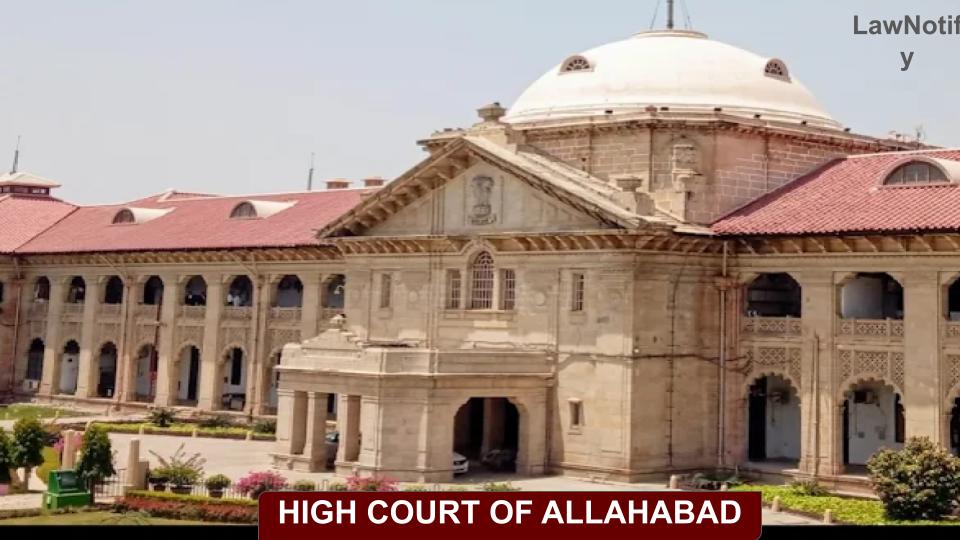
July 11, 2026 : The Allahabad High Court has declined to entertain a Public Interest Litigation (PIL) seeking directions to restrain the Uttar Pradesh Police from allegedly removing portraits of prominent Iranian Shia religious leaders from private properties across the State. The Court held that the petition was based on vague and unsubstantiated allegations and did not disclose the factual foundation necessary for invoking its writ jurisdiction under Article 226 of the Constitution.
A Division Bench comprising Justice Rajan Roy and Justice Manjive Shukla disposed of the PIL filed by Majlis Ulema-E-Hind through its General Secretary, Maulana Syed Kalbe Jawad Naqvi. The Bench observed that the petition failed to present any specific instance of police interference and therefore did not warrant judicial intervention in public interest jurisdiction.
According to the petitioner, police authorities across Uttar Pradesh had been interfering with the peaceful display of portraits, banners and other visual representations of internationally recognised Shia spiritual leaders, including the late Ayatollah Seyyed Ali Khamenei and Ayatollah Seyyed Ali Al-Sistani, during religious mourning gatherings. It was alleged that residents were compelled to remove such portraits and that criminal proceedings had been initiated against peaceful mourners, violating their fundamental rights under Articles 19 and 25 of the Constitution.
The petition sought a writ of mandamus directing all District Police Chiefs, Superintendents of Police and Station House Officers in Uttar Pradesh not to take coercive action against persons peacefully displaying portraits of Shia religious leaders or participating in religious mourning ceremonies. It also requested the Court to restrain the police from removing portraits, banners and other visual representations displayed on private residential and commercial properties and to direct the State authorities to decide representations submitted on June 12, 2026.
After examining the pleadings, the High Court found that the petition contained only broad and general allegations without identifying a single specific incident of police action. The Bench noted that the petitioner had not disclosed the location of any residence or commercial establishment from where portraits had allegedly been removed, nor had it explained when, how or by whom such action was taken.
The Court held that such omnibus allegations, unsupported by concrete facts or evidence, were insufficient to invoke the extraordinary jurisdiction of the High Court under Article 226. It reiterated that a Public Interest Litigation cannot be entertained on the basis of vague assertions lacking a clear factual foundation.
Clarifying the legal position, the Bench observed that any individual aggrieved by a specific illegal act of a police officer is free to pursue the statutory remedies available under law before the appropriate forum. However, in the absence of any identifiable cause of action or substantiated allegations, no blanket directions could be issued against the State police machinery.
Accordingly, the Allahabad High Court declined to grant the relief sought and disposed of the writ petition without issuing any directions to the State Government or the police authorities.