News Citation : 2026 LN (HC) 421
August 17, 2026 : The Chhattisgarh High Court at Bilaspur has upheld the conviction of a former Patwari in a 23-year-old bribery case, holding that the prosecution successfully established the demand and acceptance of illegal gratification through circumstantial evidence even though the alleged tape recording of the bribe conversation was not produced before the Court. However, considering the appellant’s advanced age and the long passage of time since the offence, the Court reduced his sentence.
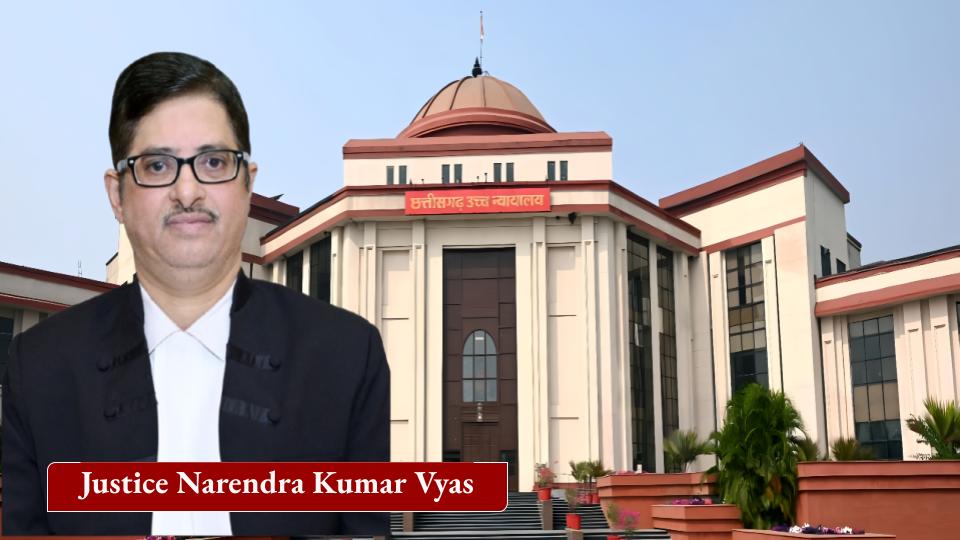
Justice Narendra Kumar Vyas delivered the judgment on August 17, 2026, in Criminal Appeal No. 536 of 2017, filed by Madhav Singh Chandel against the judgment of the Special Judge under the Prevention of Corruption Act, Durg. The trial court had convicted Chandel under Sections 7 and 13(1)(d) read with Section 13(2) of the Prevention of Corruption Act, 1988 and sentenced him to one year and two years of rigorous imprisonment respectively, with both sentences to run concurrently.
The prosecution case arose from a complaint lodged before the Anti-Corruption Bureau in December 2003. According to the complaint, the appellant, who was then working as a Patwari, had allegedly demanded Rs. 2,000 from the complainant for attestation and related revenue-record work concerning land purchased by his mother. The prosecution further alleged that an earlier amount of Rs. 5,000 had already been paid in connection with partition and correction of revenue records.
Following the complaint, the Anti-Corruption Bureau constituted a trap team and prepared tainted currency notes using phenolphthalein powder. On December 31, 2003, the complainant went to the Patwari’s office and allegedly handed over Rs. 2,000 to the appellant. After the pre-arranged signal was given, the trap team entered the chamber and apprehended him. The tainted currency was subsequently recovered from a bag associated with the appellant, while the sodium carbonate solution used during the trap proceedings turned pink. The prosecution later filed a charge-sheet after obtaining sanction for prosecution.
During the appeal, the former Patwari challenged the conviction on several grounds. His counsel argued that the prosecution had failed to produce the tape recorder allegedly used to record the conversation relating to the demand for bribe, along with its transcription or any witness connected with the recording. It was also argued that important witnesses, including persons allegedly present at the spot, had not been examined. The defence questioned the recovery of the tainted money from the bag, contending that the money was not recovered from the appellant’s person and that the bag could have been accessed by someone else.
The appellant also relied upon alleged contradictions in the evidence concerning the trap, the signal given to the Anti-Corruption Bureau team and the exact manner in which the tainted currency reached the bag. His counsel further argued that the prosecution had not established that the appellant was legally responsible for the attestation work forming the basis of the alleged demand. Several Supreme Court and High Court decisions were cited in support of the appeal.
The State opposed the appeal and maintained that the trial court had correctly appreciated the evidence. According to the prosecution, the demand and acceptance of the bribe had been established through the testimony of the complainant and other witnesses as well as the trap and recovery proceedings.
The High Court identified the central question as whether the prosecution had proved the alleged demand for illegal gratification beyond reasonable doubt, which was necessary to sustain the conviction under Section 7 of the Prevention of Corruption Act.
The Court acknowledged an important weakness in the prosecution case. The alleged tape recording, its transcription and the witness connected with the recording had not been produced before the Court. Referring to the Supreme Court’s decision in R.M. Malkani v. State of Maharashtra, the High Court noted that a tape recording can constitute primary evidence for proving such a conversation.
However, the Court made it clear that the absence of the recording was not automatically fatal to the prosecution. Relying upon the Constitution Bench judgment of the Supreme Court in Neeraj Dutta v. State (Government of NCT of Delhi), the High Court reiterated that demand and acceptance of illegal gratification may be established not only through direct oral or documentary evidence but also through circumstantial evidence.
The Court emphasized that “proof of demand and acceptance of illegal gratification” is essential for conviction under the relevant provisions of the Prevention of Corruption Act. At the same time, such proof can be established through circumstances when direct evidence is unavailable. The High Court also referred to the Supreme Court’s subsequent decisions in A. Karunanithi v. State and State by Lokayukta Police v. Sri K. Rangayya and Anr., which reaffirmed the requirement of proving demand and acceptance.
Applying these principles, the High Court found that the evidence of the complainant remained consistent on the material aspect of the alleged demand despite extensive cross-examination. The complainant stated that he had handed over the money to the appellant, who placed it in a bag. Manharan Lal, another prosecution witness, also supported the allegation that Rs. 2,000 had been demanded for the revenue-related work and that the money was subsequently placed in the bag.
The Court also considered the evidence of the trap witnesses. Although one witness had initially turned hostile, he admitted the seizure proceedings, the matching of currency-note numbers and the chemical test conducted on the seized notes. Another witness supported the solution test and confirmed that the bag was hanging from the appellant’s chair.
The defence had argued that the Patwari did not have authority to perform the relevant attestation. The High Court, however, examined the revenue records and the evidence of the defence witnesses and found that after the partition order, correction of the revenue records and insertion of the relevant name were duties connected with the Patwari’s work. The Court also considered Section 109 of the Land Revenue Code, which requires acquisition of rights or interests in land to be reported to the Patwari and provides for the Patwari’s role in the revenue-record process.
On the cumulative assessment of the evidence, the High Court concluded that the prosecution had established both demand and acceptance of illegal gratification beyond reasonable doubt. It therefore held that the essential ingredients of the offences under Sections 7 and 13(1)(d) read with Section 13(2) of the Prevention of Corruption Act had been proved through circumstantial evidence.
The Court consequently declined to interfere with the finding of guilt recorded by the Special Judge in 2017. However, the High Court separately considered the question of sentence. The appellant submitted that he was now 73 years old, had lost his government service following the conviction and had not received monetary benefits such as pension or gratuity. He also pointed out that the incident had occurred approximately 23 years earlier and that he had remained on bail after the High Court granted bail in April 2017.
The State opposed any substantial reduction, stressing the seriousness of corruption by a public servant and arguing that the trial court had already taken a lenient view. The prosecution also submitted that the statutory minimum sentence applicable at the time of the offence could not be reduced to the one day already undergone by the appellant.
The High Court agreed that the sentence could not be reduced to the period already undergone because the statute prescribed a minimum term of imprisonment. In reaching this conclusion, the Court relied upon the Supreme Court’s decision in Shanti Lal Meena v. State of NCT of Delhi, CBI, which stresses the importance of proportionate and deterrent punishment in corruption cases.
The High Court observed that corruption offences require an approach that preserves public confidence in the administration of justice. Referring to the Supreme Court’s reasoning, the judgment notes that “misplaced sympathy or unwarranted leniency” in corruption cases could undermine public confidence and dilute the deterrent purpose of the law.
Nevertheless, the High Court found that the appellant’s age and the fact that the offence had taken place 23 years earlier constituted mitigating circumstances. The Court therefore reduced the sentence under Section 7 of the Prevention of Corruption Act from one year to six months and the sentence under Section 13(1)(d) read with Section 13(2) from two years to one year. Both sentences will continue to run concurrently.
The conviction was thus maintained, but the appeal was partly allowed only to the extent of reducing the sentence. As the appellant was reported to be on bail, the High Court cancelled his bail bonds and directed him to surrender before the trial court on October 30, 2026, to serve the remaining sentence.
The judgment is significant for anti-corruption prosecutions because it reiterates that proof of demand and acceptance remains the foundation of a conviction under the Prevention of Corruption Act. At the same time, the ruling clarifies that the prosecution does not necessarily fail merely because a purported audio recording is unavailable. Where the surrounding circumstances, witness testimony, recovery and other evidence form a coherent chain establishing demand and acceptance beyond reasonable doubt, circumstantial evidence can sustain the conviction.
The decision also illustrates the distinction between maintaining a conviction and modifying the sentence. While the High Court found no sufficient basis to disturb the finding of guilt, it exercised sentencing discretion in view of the appellant’s age and the extraordinary delay between the offence and the final appellate judgment. The judgment therefore preserves the deterrent character of anti-corruption law while taking account of individual mitigating circumstances at the sentencing stage.
Case Reference: Madhav Singh Chandel v. State of Chhattisgarh, Criminal Appeal No. 536 of 2017