News Citation : 2026 LN (HC) 435
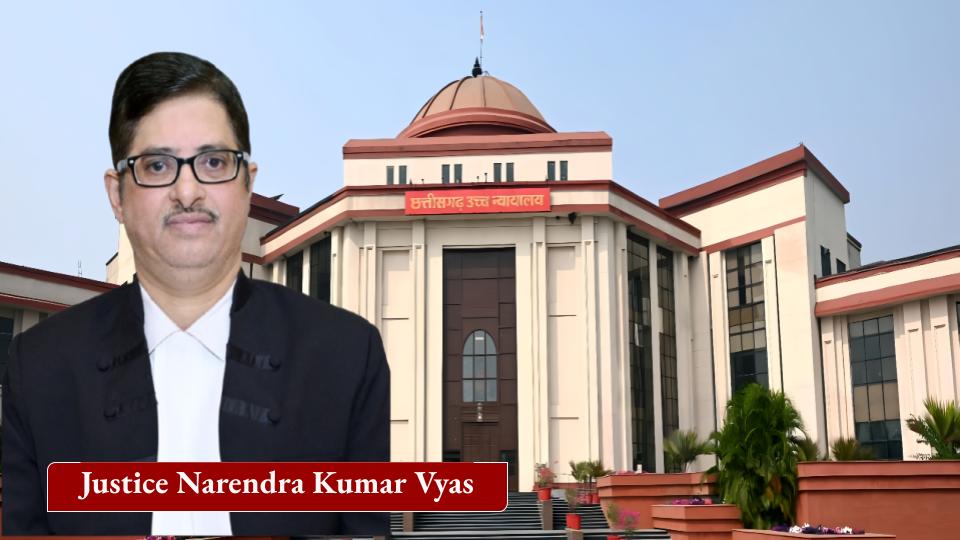
The Chhattisgarh High Court has held that an acquittal in a criminal case under Section 498A of the Indian Penal Code does not prevent a woman from subsequently pursuing a complaint under Section 12 of the Protection of Women from Domestic Violence Act, 2005, even when both proceedings arise from the same set of allegations. Justice Narendra Kumar Vyas observed that the two provisions operate in different spheres and serve distinct legal purposes.
The ruling came in Criminal Miscellaneous Petition (CRMP) No. 1472 of 2025, filed by Manoj Kurre and four members of his family challenging the registration and cognizance of a domestic violence complaint pending before the Judicial Magistrate First Class, Champa, in Complaint Case No. 02/2020. The High Court passed the order on August 20, 2026.
The petitioners argued that the domestic violence proceedings were based on the same allegations for which the complainant had earlier lodged an FIR under Section 498A IPC. According to their counsel, the accused persons had already been acquitted in that criminal case. It was also submitted that the parties had subsequently obtained a divorce and that proceedings concerning custody of their minor child were pending before a Division Bench of the High Court.
The original complaint was filed by Sunita Kurre against her husband and other family members. She alleged that her husband was not taking care of her and that she had been subjected to mental torture in connection with a demand for Rs. 1 lakh and a motorcycle as dowry. She also sought Rs. 3,000 per hearing towards litigation expenses and Rs. 30,000 towards the cost of litigation.
The petitioners contended that, in view of their acquittal in the earlier Section 498A IPC case, continuing the domestic violence complaint amounted to an abuse of the process of law. They therefore sought quashing of the complaint and the proceedings initiated before the Magistrate.
The respondents were served with notice by the High Court but did not appear. The Court therefore considered the matter on the basis of the record and materials placed by the petitioners.
Rejecting the central argument of the petitioners, Justice Narendra Kumar Vyas explained that Section 498A IPC and Section 12 of the Protection of Women from Domestic Violence Act, 2005 are legally distinct provisions. The Court noted that they “operate in different fields and serve distinct objects.”
The High Court also relied on Section 36 of the Domestic Violence Act, which expressly provides that the provisions of the Act are in addition to, and not in derogation of, other laws in force. According to the Court, this statutory framework makes it clear that proceedings under the Domestic Violence Act are not automatically excluded merely because criminal proceedings under Section 498A IPC have already concluded.
The Court specifically held that “the acquittal of the petitioner under Section 498A of the I.P.C. will not prohibit or restrict the complainant to file a complaint under Section 12 of the Act of 2005.”
Section 498A IPC, as it existed for the proceedings referred to in the order, dealt with cruelty by a husband or his relatives towards a married woman. By contrast, Section 12 of the Protection of Women from Domestic Violence Act provides a mechanism through which an aggrieved woman can approach a Magistrate seeking relief under the Act. The domestic violence legislation has a broader protective framework addressing violence within the domestic relationship and provides civil and protective remedies in addition to criminal law consequences.
The distinction is significant because an acquittal in a criminal prosecution does not necessarily determine every issue arising under a different statutory framework. The High Court’s ruling makes clear that the existence of an earlier acquittal cannot, by itself, be used as a ground to terminate proceedings under the Domestic Violence Act at the threshold.
The Court therefore concluded that the Trial Court had not committed any illegality in taking cognizance of the complaint. At the same time, the High Court clarified that its dismissal of the petition would not prevent the Trial Court from examining the domestic violence complaint on its own merits.
The Court directed that the Trial Court’s decision should not be influenced by any observation made in the High Court’s order. The CRMP was accordingly disposed of.
The judgment reinforces the independent statutory character of remedies under the Protection of Women from Domestic Violence Act, 2005. For litigants, the ruling means that an acquittal under Section 498A IPC cannot automatically foreclose a separate domestic violence proceeding when the statutory requirements of the 2005 Act are otherwise satisfied. The allegations and evidence in that proceeding must still be examined independently by the competent court.
The case also highlights the distinction between criminal prosecution for cruelty and the protective and remedial framework created by the Domestic Violence Act. The High Court did not make any finding on whether the allegations made by the complainant were ultimately proved. It only held that the domestic violence complaint could not be quashed solely on the ground of the earlier acquittal.
Case Reference: Manoj Kurre & Others v. Sunita Kurre & Another, CRMP No. 1472 of 2025.