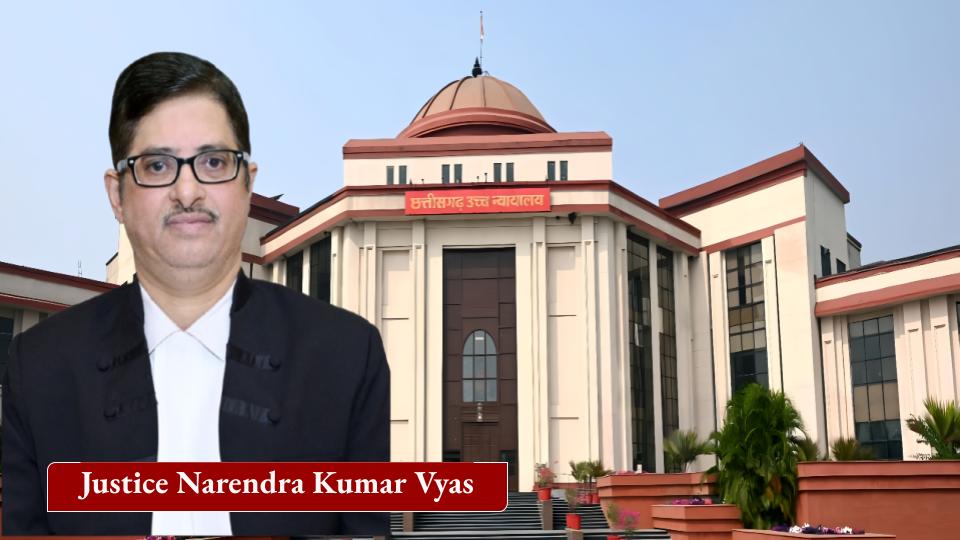
Bilaspur : The Chhattisgarh High Court has set aside the conviction of a man sentenced to 10 years of rigorous imprisonment in a case involving the alleged seizure of 374.620 kg of ganja from a truck. The Court held that serious inconsistencies in the packaging records, missing entries in the police malkhana register, an unexplained six-day gap in the delivery of the sample to the Forensic Science Laboratory (FSL), and the failure to examine the police constable who carried the sample undermined the prosecution’s chain of custody.
Justice Naresh Kumar Chandravanshi, deciding Criminal Appeal No. 193 of 2021 on October 15, 2026, concluded that the prosecution had failed to establish beyond reasonable doubt that the sample examined by the laboratory was the same substance allegedly seized from the appellant, Mohammed Abdul Shakoor. Extending the benefit of reasonable doubt, the Court acquitted him of the charge under Section 20(b)(ii)(C) of the Narcotic Drugs and Psychotropic Substances Act, 1985 (NDPS Act).
The High Court directed that the appellant be released forthwith if he was not required in any other case and ordered that the fine paid by him be refunded.
Background: 374.620 Kg of Ganja Allegedly Seized from Truck
According to the prosecution, the case originated on November 18, 2017, when a police officer at Farasgaon Police Station in Chhattisgarh’s Kondagaon district received secret information that a truck travelling from Jagdalpur towards Farasgaon was carrying narcotic substances for sale.
The police recorded the information, informed the superior officer and organised a blockade on National Highway 30 near Farasgaon Police Station. At around 4 pm, the police intercepted the truck and identified its driver as Mohammed Abdul Shakoor, a resident of Banka district in Bihar.
The investigating officer informed Shakoor of his legal right under Section 50 of the NDPS Act to have the search conducted before a Gazetted Officer or Magistrate. Following his consent to the search by the investigating officer, the police searched the vehicle and allegedly recovered 122 packets containing suspected ganja from its rear portion.
The seized substance weighed 374.620 kg. The prosecution subsequently deposited the seized material in the police malkhana and conducted inventory and sampling proceedings on November 25, 2017, in the presence of the Tehsildar-cum-Executive Magistrate. A sample was later sent to the FSL in Raipur, where laboratory analysis identified the substance as ganja.
Following the investigation, the police filed a charge sheet under Section 20(b)(ii)(C) of the NDPS Act, which deals with offences involving commercial quantities of cannabis. The Special Judge under the NDPS Act, Kondagaon, convicted Shakoor on December 26, 2020, and sentenced him to 10 years of rigorous imprisonment with a fine of ₹1 lakh. An additional year of rigorous imprisonment was prescribed in default of payment of the fine.
Shakoor challenged the conviction before the High Court under Section 374(2) of the Code of Criminal Procedure, 1973.
Defence Highlights Contradictions in Seizure and Storage Records
Before the High Court, the appellant’s counsel, Kiran Jain and Rajesh Jain, argued that the prosecution had failed to establish the identity and safe custody of the seized substance from the time of recovery until its examination by the FSL.
The defence pointed out that the seizure memo did not specify whether the 122 packets had been kept in plastic or jute sacks. However, the malkhana register recorded that the seized material had been deposited in 14 plastic sacks. The subsequent panchnama referred to 14 jute sacks, while the inventory proceedings conducted before the Executive Magistrate referred to 40 jute sacks.
The records also contained conflicting references to 30 and 40 sacks during the inventory and sampling proceedings. Although a prosecution witness described the reference to 30 sacks as a typographical error, the defence argued that this explanation did not resolve the other inconsistencies concerning the packaging and movement of the seized material.
The defence further questioned the handling of the samples prepared on November 25, 2017. According to the prosecution records, sample A-1 was forwarded to the FSL on January 10, 2018, but the laboratory receipt showed that it was received only on January 16, 2018.
The appellant’s counsel argued that the prosecution had not explained where the sample remained during those six days. The constable allegedly responsible for carrying the sample to the laboratory, Chaitram Netam, was also not examined during the trial.
On these grounds, the defence contended that the prosecution had failed to establish an unbroken chain of custody, making the conviction unsafe.
State Argues Recovery and FSL Report Support Conviction
Opposing the appeal, the State’s counsel, Khulesh Sahu, submitted that the discrepancies identified by the defence were not sufficient to invalidate the prosecution case. The State maintained that the total weight of the seized substance remained unchanged and that the prosecution witnesses had established the recovery of a commercial quantity of ganja from the truck driven by the appellant.
The prosecution also relied on the inventory proceedings conducted by the Executive Magistrate and the FSL report confirming that the sample contained ganja. According to the State, the trial court had properly assessed the oral and documentary evidence, and there was no ground for interference with the conviction.
After hearing both sides and examining the evidence, the High Court identified the central issue as whether the prosecution had established a reliable connection between the substance allegedly seized from the truck and the sample analysed by the laboratory.
High Court Finds Serious Breaks in Chain of Custody
The Court observed that proving the initial recovery of a suspected narcotic substance is not sufficient by itself. The prosecution must also establish that the sample sent for chemical examination was drawn from the seized material and remained secure, identifiable and untampered with throughout its custody.
The judgment emphasised that the FSL report could not independently resolve doubts about the identity of the sample. As the Court explained, the laboratory’s finding that the sample contained ganja did not establish that the sample necessarily originated from the substance allegedly recovered from the appellant.
The Court observed:
“the prosecution has failed to satisfactorily establish the aforesaid essential link in the chain of custody.”
The Court considered the inconsistencies in the seizure memo, malkhana register, sampling panchnama and inventory proceedings collectively rather than treating each discrepancy as an isolated clerical mistake.
The investigating officer had testified that the substance was deposited in 14 plastic sacks, whereas subsequent records described 14 jute sacks and, later, 40 jute sacks. The inventory documents also referred to the material being packed in 11 plastic sacks and four jute sacks after sampling. The Executive Magistrate acknowledged discrepancies in the records and stated that the reference to 30 sacks instead of 40 was a clerical error.
However, the High Court found that the explanation did not reconcile the different descriptions of the packaging and the subsequent movement of the seized substance. The Court also noted that photographs showing the alleged plastic sacks had not been produced in evidence.
These inconsistencies assumed greater significance because the prosecution had to establish the identity and continuity of custody of the material relied upon to prove the NDPS charge.
Missing Malkhana Entries Weaken Prosecution Case
Another significant concern was the absence of contemporaneous entries documenting the movement of the seized material within the police malkhana.
The malkhana in-charge, Shivprasad Thakur, testified that the samples and the remaining contraband had been deposited after the inventory and sampling proceedings. However, during cross-examination, he admitted that the register did not record the withdrawal of the seized articles for sampling on November 25, 2017, or their subsequent redeposit.
He also acknowledged that the register did not specifically record that the deposited articles were in a sealed condition.
The High Court clarified that a missing register entry does not automatically establish that evidence has been tampered with. Nevertheless, when such omissions occur alongside inconsistent packaging records and unexplained movement of the samples, they can materially affect the reliability of the prosecution’s evidence.
The Court found that the prosecution had not satisfactorily demonstrated how the sample was secured after its preparation or how its identity and integrity were maintained before it was sent for laboratory examination.
Six-Day Delay in FSL Delivery Remains Unexplained
The unexplained interval between the dispatch and receipt of the sample at the FSL was particularly important to the Court’s decision.
The sample was reportedly prepared during inventory proceedings on November 25, 2017. The Superintendent of Police, Kondagaon, issued a forwarding memo dated January 10, 2018, for sending sample A-1, weighing 100 grams, to the FSL in Raipur. However, the laboratory receipt showed that the sample was received on January 16, 2018.
The prosecution did not establish where the sample remained during the intervening six days or explain the circumstances in which it was transported and delivered.
The Court further noted that the prosecution had not examined Constable No. 699, Chaitram Netam, who allegedly carried the sample to the laboratory. His testimony could have clarified when he received the sample, the condition in which it was handed over to him, and when and how it was delivered to the FSL.
The absence of this testimony, coupled with the lack of documentary evidence explaining the sample’s movement, left a material gap in the chain of custody.
The judgment stressed that the integrity of a sample must be established through credible oral and documentary evidence. An FSL report identifying a substance as ganja cannot, by itself, cure deficiencies in proving that the sample examined was the same material allegedly seized from the accused.
Supreme Court Precedent on Chain of Custody Considered
The High Court also relied on the Supreme Court’s judgment in Abdul Rajik v. State of Madhya Pradesh and Govind v. State of Madhya Pradesh, Criminal Appeal Nos. 1561 and 1562 of 2014, respectively, reported as 2026 INSC 1001 and decided on September 16, 2026.
According to the High Court’s discussion of the precedent, the Supreme Court reiterated that the prosecution must establish the complete chain of custody through reliable oral and documentary evidence. An unexplained gap in the custody of samples, particularly when the person who transported them to the laboratory has not been examined, may undermine the evidentiary value of the FSL report.
Applying that principle, the High Court found that the shortcomings in the present case were not limited to the six-day interval. The discrepancies in the packaging, the absence of malkhana entries documenting withdrawal and redeposit, and the failure to examine the carrier constable collectively raised serious doubts about the identity and integrity of the sample.
The Court therefore held that the prosecution could not rely on the laboratory report as conclusive proof of the nature of the substance allegedly seized from Shakoor.
Recovery Evidence Alone Could Not Sustain NDPS Conviction
The High Court acknowledged that police witnesses had supported the prosecution’s account of the truck being intercepted and 122 packets being recovered. It also clarified that the prosecution case could not be rejected merely because independent witnesses had turned hostile.
However, the Court distinguished between proving that a recovery took place and proving that the recovered substance was the contraband alleged in the charge.
The Court explained that the prosecution’s reliance on chemical examination made it essential to establish a dependable evidentiary link between the substance seized at the spot and the sample examined in the laboratory.
In the Court’s assessment, the combined effect of the discrepancies meant that this essential link had not been proved beyond reasonable doubt. The trial court had failed to give adequate consideration to the cumulative effect of the material inconsistencies and the missing link evidence.
The judgment observed that the issue was not simply whether the recorded weight of the seized substance had changed. The real question concerned the identity of the seized material and whether the sample relied upon by the prosecution could be reliably connected to it.
Legal Significance Under the NDPS Act
Section 20(b)(ii)(C) of the NDPS Act prescribes punishment for offences involving cannabis in commercial quantities. Such offences carry stringent penal consequences, making reliable proof of the seized substance and the integrity of the evidence especially important.
Section 42 of the NDPS Act governs the recording and communication of information in specified circumstances involving searches and seizures. Section 50 concerns safeguards applicable to the personal search of an individual. Section 52A addresses the disposal of seized narcotic drugs and psychotropic substances and provides for inventory, certification and related evidentiary procedures.
In this case, the High Court’s decisive concern was the reliability of the chain of custody and the identity of the sample examined by the FSL. The judgment does not establish that every discrepancy in a seizure record automatically invalidates a prosecution. Rather, it demonstrates that material inconsistencies, when considered together with missing custody records and unexplained gaps in sample transportation, may create reasonable doubt about the prosecution’s evidence.
The decision reinforces the importance of accurate seizure documentation, proper storage records, documented sample movement, secure sealing procedures and evidence explaining the transfer of samples to forensic laboratories.
For investigating agencies, the ruling highlights the need to maintain consistent records from the initial seizure through malkhana storage, inventory, sampling, dispatch and laboratory receipt. For accused persons facing NDPS charges, it underscores the evidentiary significance of genuine and material gaps in the prosecution’s chain of custody.
Conviction Set Aside; Appellant Acquitted
Allowing Criminal Appeal No. 193 of 2021, the Chhattisgarh High Court set aside the judgment of conviction and order of sentence dated December 26, 2020, passed by the Special Judge under the NDPS Act, Kondagaon, in Special Criminal Case No. 20 of 2018.
The Court acquitted Mohammed Abdul Shakoor of the charge under Section 20(b)(ii)(C) of the NDPS Act by extending the benefit of reasonable doubt. It directed that he be released forthwith if he was not required in any other case and that the fine amount be refunded if already deposited.
The Court also directed that the appellant’s bail bonds remain in operation for six months in accordance with Section 481 of the Bharatiya Nagarik Suraksha Sanhita, 2023 (BNSS), and ordered that the trial court record be returned for compliance.
Case Reference: Mohammed Abdul Shakoor v. State of Chhattisgarh, Criminal Appeal No. 193 of 2021.
Counsel for the Appellant: Ms. Kiran Jain and Mr. Rajesh Jain, Advocates.
Counsel for the State: Mr. Khulesh Sahu, Panel Lawyer.