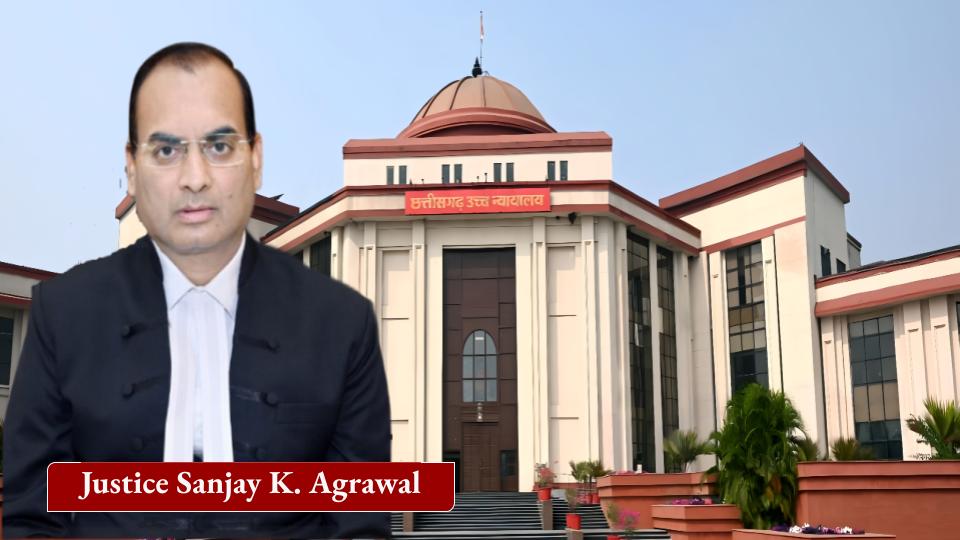
Bilaspur : The Chhattisgarh High Court at Bilaspur has dismissed two writ petitions challenging the use of graduation percentage as a screening criterion for recruitment to posts in the district judiciary. Justice Bibhu Datta Guru held that recruiting authorities can adopt a reasonable and objective shortlisting method when the number of applicants is large, even if the recruitment rules or advertisement do not expressly prescribe such a procedure.
The order was passed on October 12, 2026, in Anil Kumar v. State of Chhattisgarh & Others (WPS No. 7303 of 2026) and Sudhir Toppo v. State of Chhattisgarh & Others (WPS No. 7304 of 2026). The petitioners were represented by Advocates Siddhant Sharma and Syed Jayed Ziya Ali. Government Advocate Suyashdhar Badgaiya appeared for the State, while Advocate H.S. Ahluwalai represented the High Court and other respondents.
The petitions challenged graduation-percentage screening criteria introduced in recruitment advertisements for Stenographer Grade-3, Assistant Grade-3 and Peon posts in the district judiciary at Raipur, Rajnandgaon, Mungeli and Surguja. The petitioners argued that they possessed the prescribed educational qualifications and should therefore be allowed to appear in the written examination. According to them, imposing an additional graduation-percentage requirement restricted the opportunity of otherwise eligible candidates and raised concerns about the uniformity of the selection process.
Opposing the petitions, the respondents submitted that the recruitment process was being conducted under the applicable Chhattisgarh District Judiciary Establishment (Recruitment and Conditions of Service) Employees Rules, 2023. They argued that a large number of applications made it necessary to adopt an objective and manageable screening mechanism to ensure the orderly and timely completion of recruitment.
The High Court examined the distinction between minimum eligibility qualifications and shortlisting criteria. It observed that possessing the prescribed educational qualification does not automatically give every applicant an absolute right to participate in every stage of recruitment. However, any screening method must be reasonable, objective, non-discriminatory and consistent with the applicable recruitment framework.
Relying on the Supreme Court’s decision in B. Ramakichenin @ Balagandhi v. Union of India, reported in (2008) 1 SCC 362, Justice Guru reiterated that shortlisting may be adopted when the number of eligible applicants makes it impracticable to take all candidates to the next stage. The Court also clarified that if the recruitment rules or advertisement prescribe a particular shortlisting procedure, the recruiting authority must follow that method.
The Court observed that the power to shortlist candidates is not unlimited. Recruiting authorities cannot disregard an expressly prescribed selection procedure or introduce an arbitrary criterion unrelated to the recruitment process. In the present cases, however, the petitioners had not produced sufficient material to establish that the challenged criteria violated the applicable rules, were discriminatory, or had been selectively applied to exclude them.
The petitioners’ argument that all eligible candidates should first be permitted to sit for the written examination was also rejected. The Court held that candidates cannot insist on a particular sequence of selection merely because it is more favourable to them. It further found that recruitment procedures followed in other districts did not, by themselves, establish a legal right to demand the same method in the challenged recruitments.
Accordingly, the High Court found no sufficient ground to quash the screening clauses or direct the authorities to allow all otherwise eligible candidates to appear directly in the written examination. Both writ petitions were dismissed, along with any pending applications.
The ruling clarifies that graduation marks may be used as a shortlisting tool in recruitment, subject to the governing rules and the requirements of fairness and non-arbitrariness. It does not give recruiting authorities unrestricted power to impose additional eligibility conditions. For candidates seeking government employment, the decision underscores the importance of examining recruitment advertisements carefully and challenging screening criteria with specific evidence of illegality, discrimination or violation of the applicable rules.