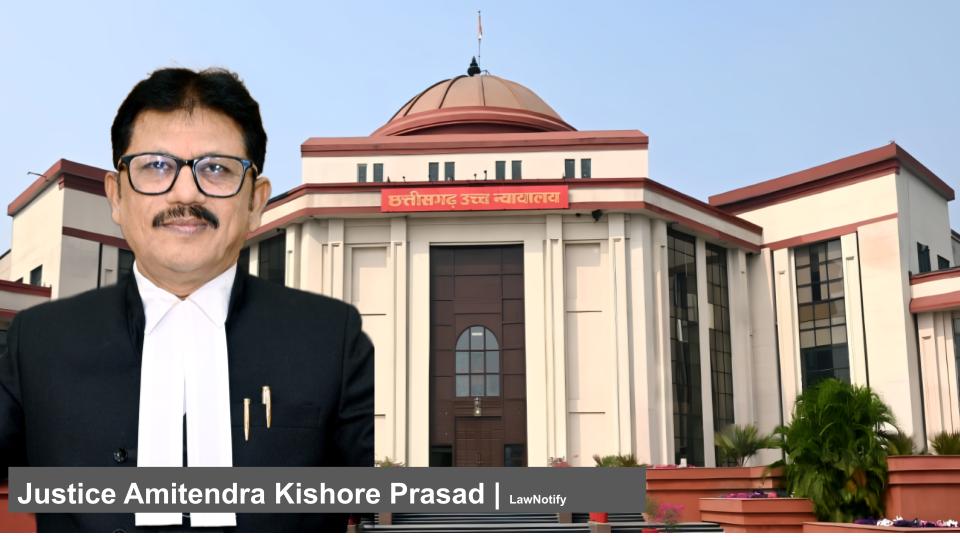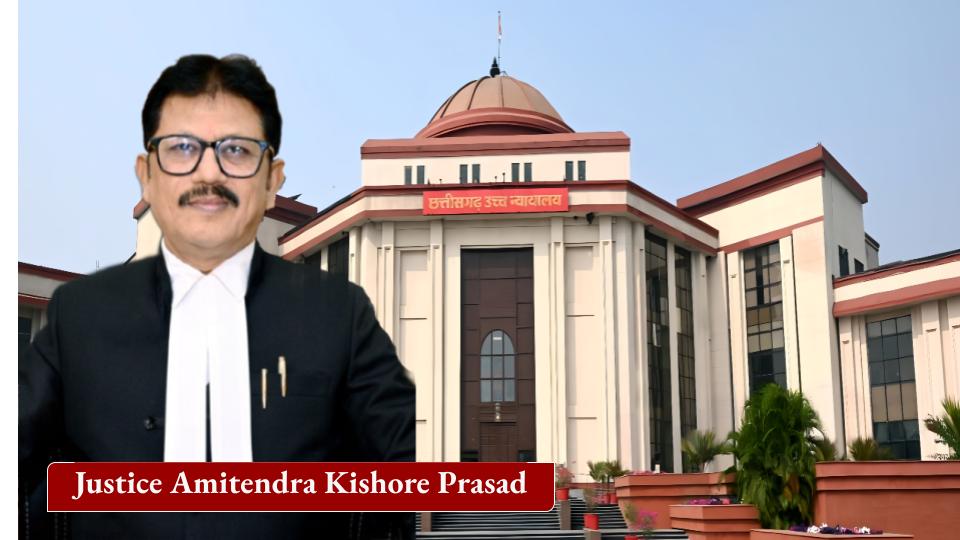
Bilaspur : The Chhattisgarh High Court at Bilaspur has directed an independent re-evaluation of the answer books of a BDS Final Year student after finding prima facie indications of arbitrary and mechanical evaluation in four theory subjects. Justice Amitendra Kishore Prasad, while allowing WPC No. 4476 of 2026, held that although re-evaluation is ordinarily not a matter of right, the High Court can exercise its constitutional jurisdiction under Article 226 in rare and exceptional cases where glaring evaluation errors cause grave injustice.
The petition was filed by Shirin Akhtar, a BDS student of New Horizon Dental College and Research Institute, Bilaspur, against the State of Chhattisgarh, Directorate of Medical Education, Directorate of AYUSH, Pandit Deendayal Upadhyay Memorial Health Sciences and Ayush University of Chhattisgarh and the concerned dental college. She challenged the marks awarded to her in Public Health Dentistry, Periodontology, Oral and Maxillofacial Surgery, and Conservative Dentistry & Endodontics in the BDS Final Year Examination held in March-April 2026.
According to the petition, the student had secured 1002 marks out of 1600 in the final examination but was declared unsuccessful because she failed to obtain the prescribed minimum marks in the theory component of four subjects. The marksheet showed theory scores of 23 in Public Health Dentistry, 18 in Periodontology, 19 in Oral and Maxillofacial Surgery and 23 in Conservative Dentistry & Endodontics, resulting in theory totals of 46, 44, 42 and 48 respectively against the minimum requirement of 50.
The petitioner pointed out that her performance in the other four theory papers was substantially higher. She secured 39, 42, 37 and 39 marks out of 70 in Orthodontics and Dentofacial Orthopaedics, Oral Medicine and Radiology, Prosthodontics and Crown & Bridge, and Pedodontics and Preventive Dentistry. She also performed well in the oral and practical components of the four disputed subjects. The High Court noted that the sharp variation in marks formed part of the circumstances requiring examination.
The student had initially sought retotalling of her marks. The University subsequently issued a notification recording “Result No Change”. She then obtained certified copies of the relevant answer books. Her counsel argued that the copies disclosed serious anomalies in the digital evaluation process, including the absence of question-wise markings, comments or other indications on the answer pages and the absence of entries in the valuation tables relating to examiners.
The question-wise marks reproduced in the judgment also became significant. For example, in Periodontology, the student received only two marks out of ten for each of two long-answer questions. The High Court further noted that zero marks had been awarded for several fully attempted short-answer questions, including certain answers in Public Health Dentistry and Conservative Dentistry & Endodontics. The Court observed that the absence of any remark explaining the award of zero marks, coupled with the nature of the answers, raised a serious prima facie question regarding the evaluation.
The petitioner argued that her answers were based on prescribed authoritative textbooks and that the digital evaluation process had resulted in a mechanical assessment. Her counsel, Mr. Soumitra Kesharwani, Advocate, submitted that retotalling could not address the real grievance because retotalling merely checks the arithmetic of marks already awarded and does not reconsider whether appropriate marks were given for correct answers. The petitioner also relied upon Article 19(1)(g) and Article 21 of the Constitution, contending that the consequences of the disputed evaluation could delay her internship, professional registration and entry into dental practice.
The University opposed the petition. Its counsel, Mr. Ajay Kumar Dwivedi, argued that the applicable regulations permitted re-evaluation in a maximum of two papers and that the petitioner could not claim re-evaluation of four subjects. The University also maintained that the answer books had been evaluated through its TCSiON-powered On-Screen Marking system by qualified subject experts and that the retotalling exercise had found no mathematical error.
The University relied on Supreme Court decisions including Dr. NTR University of Health Sciences v. Dr. Yerra Trinadh and Ran Vijay Singh v. State of U.P., arguing that courts should not ordinarily interfere with academic evaluation where the governing regulations do not provide for re-evaluation. The High Court, however, distinguished the exceptional circumstances presented by the petitioner from ordinary challenges to academic assessment.
The Court relied particularly on the Supreme Court’s decisions in High Court of Tripura v. Tirtha Sarathi Mukherjee, reported in (2019) 16 SCC 663, and Aish Mohammad v. State of Haryana, reported in (2023) 13 SCC 621. These decisions recognize that although a candidate has no ordinary legal right to demand re-evaluation in the absence of a statutory provision, Article 226 jurisdiction may still be exercised in rare cases where correct answers have demonstrably received no marks or where a glaring error in evaluation is apparent on the record.
Explaining the legal principle, the High Court observed, “judicial interference in administrative decisions, particularly in the domain of re-evaluation of answer scripts, is strictly circumscribed and cannot be directed as a matter of routine course.” However, the Court added that such intervention remains permissible where grave injustice would otherwise result and where the record demonstrates glaring mistakes or non-awarding of marks for demonstrably correct answers.
The Court found that the present case fell within that exceptional category. It noted that the answer sheets showed disproportionately low marks for certain answers which appeared correct on their face. In relation to Periodontology, for instance, the petitioner received only two marks out of ten for each of two long-answer questions despite the answers being treated as correct during the digital evaluation process. The Court also took note of zero marks awarded for several attempted answers without any apparent explanation or indication of a deficiency.
The judgment further observed that a student is expected to answer examination questions on the basis of prescribed authoritative textbooks. The Court held that “awarding zero ‘0’ marks for a detailed response submitted by an examinee is wholly unsustainable and legally impermissible” unless proper evaluation establishes that the answer is incorrect or deficient. It also held that mere retotalling could not provide an effective remedy where the dispute concerned the substantive assessment of answers.
Significantly, the Court expressed the prima facie view that there could have been an inherent flaw in the digital on-screen evaluation process or that the requisite model answers or evaluation key may not have been properly incorporated into the system. The Court held that the absence of an administrative remedy for all four disputed subjects could not prevent the exercise of the High Court’s constitutional jurisdiction under Article 226 where the record disclosed apparent evaluation anomalies.
The High Court also clarified that it was not substituting its own academic assessment for that of the examiners. Rather, it was intervening because the material placed before it disclosed circumstances warranting an independent examination of the evaluation. The Court observed that “this Court does not sit as an academic expert, [but] it cannot turn a blind eye to anomalies on the face of the record.”
The judgment also noted that the petitioner had obtained 1002 out of 1600 marks overall and had fallen short of the minimum theory requirement in the four disputed subjects by only a limited margin. The Court considered these circumstances along with her academic record and the apparent discrepancies in evaluation before concluding that the matter warranted exceptional judicial intervention.
Consequently, the Chhattisgarh High Court directed the respondent authorities to constitute an independent expert committee to re-evaluate the petitioner’s answer books in all four subjects. The re-evaluation is to be completed within one month from receipt of the certified copy of the order. Thereafter, the authorities have been directed to issue a revised marksheet for the BDS Final Year Examination held in March 2026, preferably within a further period of two months.
The ruling is significant because it reinforces the limited but important role of constitutional courts in examination disputes. The judgment does not establish a general right of students to seek judicially ordered re-evaluation. Instead, it confirms that Article 226 can be invoked in exceptional cases where the examination record itself discloses apparent arbitrariness, mechanical evaluation or failure to award marks for demonstrably correct answers. The headnote of the judgment similarly records that such intervention may be justified where disproportionately low or zero marks are awarded without apparent justification and the record indicates prima facie non-application of mind.
For students and educational institutions, the decision underscores the importance of transparent, accountable and verifiable examination systems, particularly where digital or on-screen evaluation is adopted. At the same time, the judgment preserves the principle of judicial restraint in academic matters by limiting extraordinary intervention to cases involving exceptional and demonstrable circumstances rather than ordinary dissatisfaction with marks.
Case Reference : Shirin Akhtar v. State of Chhattisgarh & Others, WPC No. 4476 of 2026