News Citation : 2026 LN (HC) 418
August 6, 2026 : In a significant judgment reaffirming the limited scope of judicial intervention in academic matters, the Chhattisgarh High Court has dismissed a writ petition challenging the deletion of certain questions from the Final Answer Key of the Chhattisgarh Teacher Eligibility Test (CG TET)-2024 (Upper Primary). The Court ruled that answer keys finalized on the recommendation of subject experts cannot ordinarily be interfered with unless they are shown to be patently arbitrary, mala fide, or contrary to law.
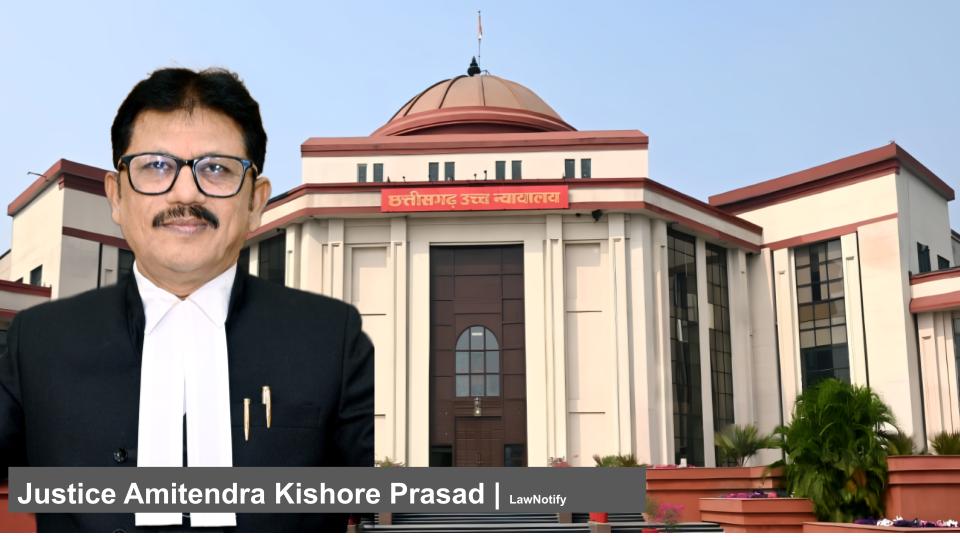
Delivering the judgment on August 6, 2026, Justice Amitendra Kishore Prasad held that courts exercising jurisdiction under Article 226 of the Constitution should exercise great restraint in examination-related disputes and must not substitute their own views for those of academic experts. The Court found that the Chhattisgarh Professional Examination Board (CG VYAPAM) had followed a structured and transparent process before deleting the disputed questions and, therefore, no interference was warranted.
The petition was filed by twenty candidates who had appeared in the CG TET-2024 (Upper Primary) examination conducted by the Chhattisgarh Professional Examination Board. They challenged the cancellation of Question No. 56 in Set-A, Question No. 55 in Set-B, and Question No. 57 in Sets-C and D, contending that the Board had acted contrary to its own examination guidelines while issuing the Final Answer Key.
According to the petitioners, under the provisional answer key they had secured qualifying marks. However, after the disputed questions were deleted in the Final Answer Key, their scores fell marginally below the qualifying benchmark of 75 marks prescribed for candidates belonging to the OBC (Non-Creamy Layer), Scheduled Castes and Scheduled Tribes categories. As a result, they became ineligible to qualify the Teacher Eligibility Test, affecting their future eligibility to participate in teacher recruitment examinations.
The petitioners argued that Clause 12 of the examination instructions permitted cancellation of a question only in limited situations, such as where the question itself was defective, none of the options was correct, there was a material discrepancy between the Hindi and English versions, or a printing error made the correct answer impossible to determine. They maintained that the disputed question suffered from none of these defects and therefore ought to have been evaluated instead of being deleted. They also clarified that they were not seeking bonus marks or re-evaluation of answer sheets, but only restoration of the deleted question and publication of a revised result.
Opposing the petition, the Chhattisgarh Professional Examination Board submitted that the disputed questions were based on a common comprehension passage. Due to printing and sequencing errors, the passage appeared after one or more related questions in certain question paper sets, making it difficult for candidates to answer the questions in the intended manner. After receiving objections from candidates, the matter was placed before an Expert Committee comprising subject specialists. The Committee concluded that the structural defect affected fairness and recommended deletion of the entire set of passage-based questions across all question sets to ensure equal treatment for every candidate. The Board stated that proportionate marks were thereafter awarded uniformly in accordance with the examination instructions.
After examining the records, the High Court accepted the Board’s explanation and found that the decision had not been taken arbitrarily. The Court noted that the issue had undergone expert scrutiny and that the Expert Committee had concluded the defective sequencing of the passage and questions could confuse candidates and compromise the fairness of the examination. The recommendation was accordingly implemented uniformly for all candidates without discrimination.
The Court reiterated that judicial review in academic matters is confined to examining the legality of the decision-making process rather than reassessing the correctness of academic decisions. Referring to the Supreme Court’s decisions in Ran Vijay Singh v. State of Uttar Pradesh (2018), Himachal Pradesh Public Service Commission v. Mukesh Thakur (2010), University of Mysore v. C.D. Govinda Rao (1965), Uttar Pradesh Public Service Commission v. Rahul Singh (2018), and Siddhi Sandeep Ladda v. Consortium of National Law Universities (2025), the Court emphasized that answer keys prepared by subject experts carry a strong presumption of correctness and should not be disturbed unless a clear and demonstrable error is established.
Explaining the legal position in simple terms, the Court observed that judges are not academic experts and cannot undertake the exercise of deciding which answer is more appropriate or whether a question should have been retained. Such issues fall within the exclusive domain of expert committees unless the decision is shown to be arbitrary, mala fide, perverse, or in violation of statutory provisions. The Court further observed, “Courts must refrain from substituting their own opinion in place of that of subject experts. Even where two views are possible, the view taken by the final academic authority must ordinarily prevail.”
Rejecting the petitioners’ reliance on the provisional answer key, the Court held that a provisional answer key does not create any vested or enforceable right in favour of candidates. The final result is always based on the Final Answer Key issued after considering objections and expert opinion. Therefore, the fact that some candidates initially secured qualifying marks under the provisional key could not justify judicial interference once the final evaluation process had been lawfully completed.
The Court also held that the Board’s reliance on Clause 12 of the examination instructions was justified because the Expert Committee had treated the defective sequencing of the passage and questions as a structural defect affecting fairness. Since the deletion was applied uniformly to all candidates and proportionate marks were awarded in accordance with the prescribed formula, no illegality or procedural impropriety could be established.
Consequently, the High Court concluded that the petitioners had failed to prove any arbitrariness, illegality, mala fide, or procedural irregularity in the Board’s decision. Holding that no exceptional circumstance existed for exercising powers under Article 226 of the Constitution, the Court dismissed the writ petition without costs.
The ruling reinforces the settled principle that courts will rarely interfere with examination authorities’ decisions regarding answer keys and evaluation when those decisions are based on expert opinion and are applied uniformly. The judgment provides further certainty to examination bodies across India that transparent decisions taken on expert recommendations will ordinarily receive judicial protection, while candidates challenging such decisions must demonstrate a clear and manifest error before constitutional courts will intervene.
Case Reference : Likesh Singh Bhardwaj & Others v. State of Chhattisgarh & Others, WPC No. 5237 of 2024