News Citation : 2026 LN (HC) 123 | 2026:CGHC:7730
February 12, 2026 : The High Court of Chhattisgarh has acquitted a former BSNL official in a corruption case dating back over two decades, holding that mere recovery of money is not enough to sustain a conviction without clear proof of demand for a bribe.
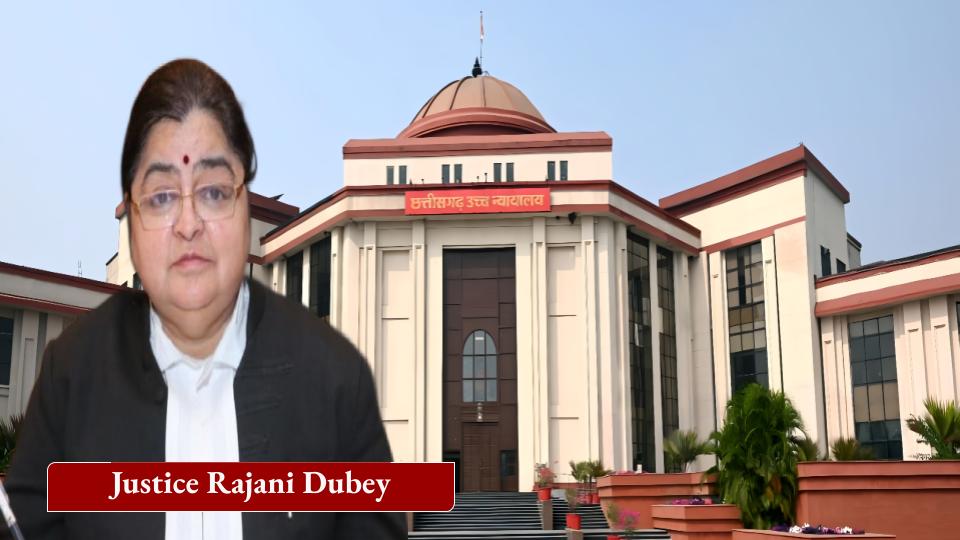
In a judgment delivered on February 12, 2026, Justice Rajani Dubey set aside the 2007 conviction of Sanjay Kumar Sharma, who had been found guilty by a CBI court under the Prevention of Corruption Act. The trial court had sentenced him to two years’ rigorous imprisonment under Section 7 and two and a half years under Section 13, with fines, in connection with an alleged bribe of Rs. 40,000.
Sharma, then serving as SDO (Phone-2) with BSNL in Bilaspur, was accused of demanding Rs. 80,000 from contractor Krishna Pal Agrawal for clearing pending bills related to cable-laying work. According to the prosecution, the complainant agreed to pay Rs. 40,000 as the first instalment and later approached the CBI. A trap was laid on June 20, 2003, and Sharma was allegedly caught while accepting the amount.
However, the High Court found that the prosecution failed to establish a crucial element required under the Prevention of Corruption Act: proof of demand for illegal gratification.
The complainant, whose testimony was central to the case, died during trial before his cross-examination could be completed. The court noted that without cross-examination, his incomplete statement could not be treated as reliable substantive evidence. His son, examined as a witness, did not support the prosecution’s version and denied knowledge of any bribe demand. He was declared hostile.
Independent witnesses who were part of the trap proceedings admitted they neither heard any conversation about a bribe nor witnessed any specific demand. Their testimony only confirmed recovery of the cash.
The court relied on settled law laid down by the Supreme Court of India in multiple judgments, including B. Jayaraj v. State of A.P. and Mukhtiar Singh v. State of Punjab, which make it clear that recovery of tainted money alone is insufficient to convict an accused under Sections 7 and 13 of the Act. Proof of demand and voluntary acceptance is mandatory.
The defence also presented an alternative explanation. A contractor, examined as a defence witness, stated that the Rs. 40,000 was part payment of labour charges owed by the complainant to him. According to his testimony, the accused was merely acting as an intermediary and had not demanded any bribe. The High Court found this explanation plausible and consistent with the surrounding circumstances.
After re-evaluating the evidence, the court concluded that the prosecution had failed to prove demand beyond reasonable doubt. Since the foundational fact of demand was not established, the statutory presumption under Section 20 of the Act could not arise. The conviction, resting solely on recovery of money, was therefore legally unsustainable.
Allowing the appeal, the High Court acquitted Sharma of all charges. As he was already on bail, the court directed him to furnish a personal bond of Rs. 25,000 for six months in case a special leave petition is filed before the Supreme Court.
The ruling reinforces a consistent judicial principle: suspicion, even if strong, cannot replace proof. In corruption cases, courts must be satisfied that demand for illegal gratification is clearly established before returning a conviction.
Case Reference : CRA No. 602 of 2007, Sanjay Kumar Sharma vs. Union of India; Counsels: For Appellant : Mr. Vivek Sharma, Advocate; For Respondent : Mr. Vaibhav A. Goverdhan, Advocate.