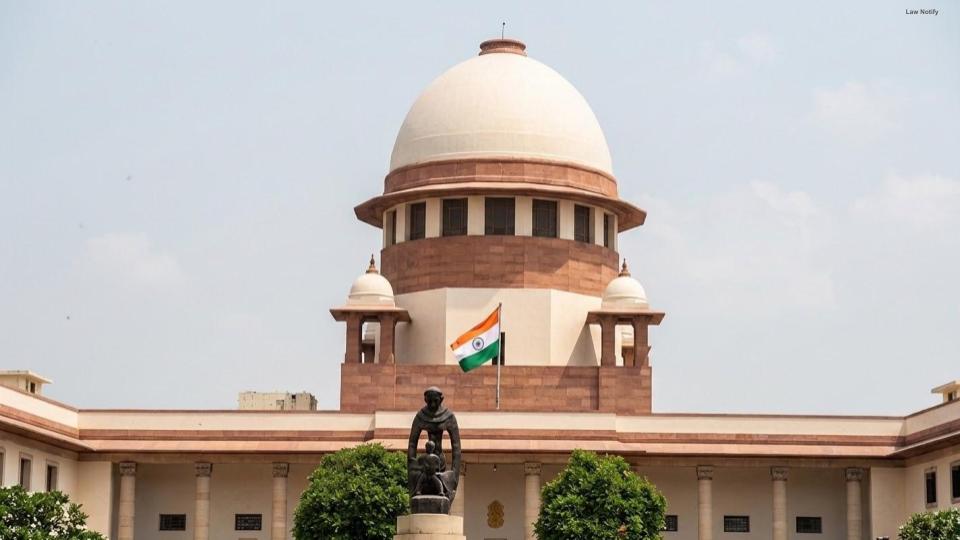
March 23, 2026 : A recent matter before the Supreme Court raised the question of whether the National Emblem should be installed atop the Court’s main dome, bringing into focus issues of constitutional symbolism and institutional procedure. The request came through a writ petition filed by a party appearing in person, seeking directions for placing the State Emblem of India on the apex court building.
The Bench comprising Chief Justice of India Surya Kant, Justice Joymalya Bagchi, and Justice Vipul Pancholi declined to examine the issue on judicial merits. It clarified that the matter falls within the administrative domain of the Court rather than requiring adjudication under writ jurisdiction. Accordingly, the Court indicated that the issue would be considered on the administrative side.
During the hearing, the Bench noted that the Supreme Court is currently undertaking infrastructure expansion, including the construction of a new building. In that context, the question of installing the National Emblem, whether on the existing structure or as part of future development, could be evaluated by the competent authorities within the Court’s administrative framework. The Court assured the petitioner that the concern would be duly considered through appropriate internal processes.
The Bench also referred to prior communication from the registry stating that the Supreme Court uses its own official emblem. However, it clarified that such communication does not preclude reconsideration. The Chief Justice indicated that the matter would be examined afresh, leaving scope for a decision after administrative deliberation.
By choosing not to issue judicial directions and instead routing the matter administratively, the Court underscored an important institutional distinction. Issues relating to internal management, architectural design, or symbolic representation do not necessarily warrant judicial intervention and are better addressed through administrative mechanisms. This approach preserves the proper scope of the Court’s adjudicatory function while respecting institutional processes.
The matter also highlights the broader role of national symbols in constitutional spaces. The use of the National Emblem carries significant symbolic weight and is governed by statutory provisions to ensure its proper use. Any decision regarding its installation must therefore align with the applicable legal framework and established institutional practices.
Overall, the Court’s response reflects a measured approach, acknowledging the concern while directing it to the appropriate forum. It reinforces the principle that the nature of an issue determines the mode and forum of its resolution.