News Citation : 2026 LN (HC) 211 | 2026:CGHC:12396-DB
March 16, 2026 : The Chhattisgarh High Court has upheld the conviction and life sentence of a man for the rape of a hearing and speech-impaired woman, firmly reiterating that testimony conveyed through gestures and signs is legally admissible and can form the basis of conviction if found reliable.
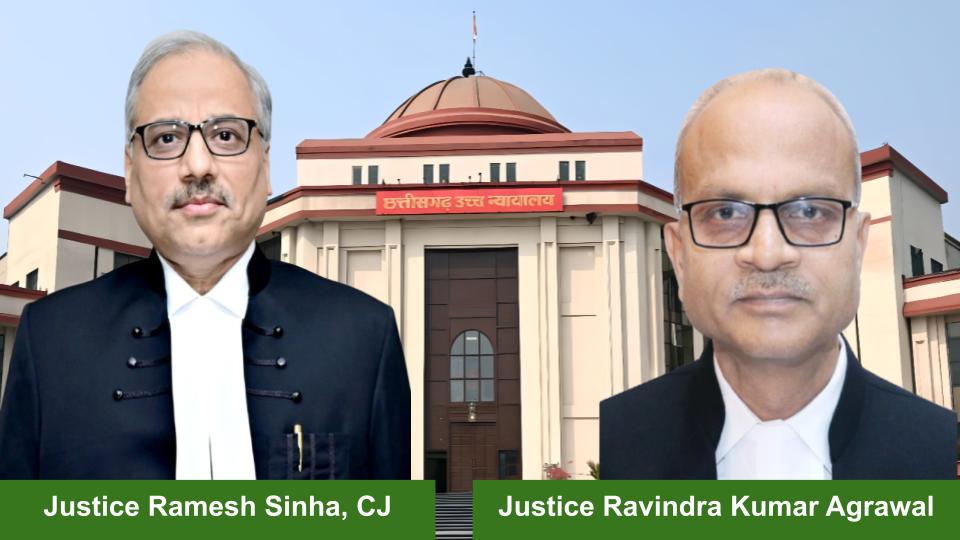
Deciding Criminal Appeal No. 786 of 2023, a Division Bench comprising Chief Justice Ramesh Sinha and Justice Ravindra Kumar Agrawal dismissed the appeal filed by the accused, Neelam Kumar Deshmukh, and affirmed the judgment of the Sessions Court, Balod.
The trial court had convicted the accused under Sections 450 (house-trespass) and 376 of the Indian Penal Code, sentencing him to rigorous imprisonment for life till natural death along with fines.
According to the prosecution, the victim, who is deaf and mute since birth, was alone at her residence when the accused, a relative, entered the house and committed rape. Upon the return of her parents, she communicated the incident through gestures, identifying the accused. An FIR was subsequently registered, and her statement was recorded with the assistance of a trained interpreter.
During trial, the court adopted demonstrative methods, including the use of a plastic doll, to facilitate communication. The victim consistently indicated through gestures that the accused had forcibly committed sexual intercourse.
The High Court rejected the defence argument that the victim was not a competent witness due to her disability. It emphasized that under law, a person unable to speak can depose through signs and gestures, and such evidence qualifies as substantive oral evidence if the court is satisfied about the witness’s capacity to understand and communicate.
The Bench noted that:
- The trial court had ensured procedural safeguards by using a trained interpreter.
- The victim’s testimony remained consistent with her earlier statements and FIR.
- Her version inspired confidence and was corroborated by surrounding circumstances.
The Court further reiterated the settled principle that conviction in rape cases can be based solely on the testimony of the prosecutrix if it is trustworthy and credible.
Corroborative Evidence
Apart from the victim’s testimony, the prosecution case was supported by:
- Immediate disclosure to her mother and consistent statements by family members and villagers
- Medical and forensic evidence confirming sexual intercourse
- Forensic Science Laboratory report detecting seminal stains and sperm on the victim’s samples and the accused’s clothing
The Court found no material inconsistencies or infirmities that could discredit the prosecution case.
Holding that the testimony of the victim was natural, consistent, and credible, the High Court concluded that her evidence constituted reliable substantive evidence. Finding no perversity in the trial court’s appreciation of evidence, the Bench dismissed the appeal and directed the accused to serve out his sentence.
Case Reference : CRA No. 786 of 2023, Neelam Kumar Deshmukh vs State of Chhattisgarh — For Appellant(s): Mr. Prasoon Agrawal, Advocate; For Respondent(s): Mr. S.S. Baghel, Government Advocate.