News Citation : 2026 LN (HC) 256
April 16, 2026 : The High Court of Chhattisgarh has partly allowed an appeal filed by the State of Chhattisgarh, setting aside a trial court’s acquittal and convicting an accused for offences under Section 354 of the Indian Penal Code (IPC), while upholding his acquittal under the Protection of Children from Sexual Offences (POCSO) Act due to failure to conclusively prove the victim’s age.
The case arose from incidents reported in August 2017 in Sarangarh, Raigarh district. According to the prosecution, a minor girl alleged that the accused repeatedly harassed her during a Ganesh Puja event. It was claimed that on multiple occasions, the accused held her hand, made sexually suggestive remarks, and touched her inappropriately, leading to a complaint being lodged by her mother.
Following investigation, the accused was charged under Section 354 IPC and Section 8 of the POCSO Act. However, the trial court acquitted him in 2018, holding that the prosecution had failed to establish the case beyond reasonable doubt.
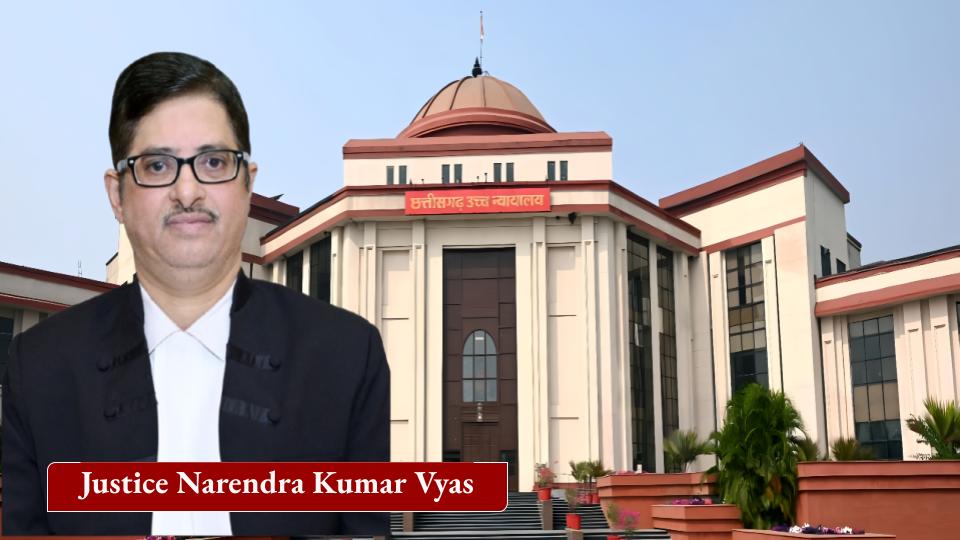
Hearing the State’s appeal, Justice Narendra Kumar Vyas closely examined the evidence and found that the trial court had erred in discarding the testimony of the victim. The High Court noted that the victim’s statements remained consistent and credible, and her explanation that her cries were not heard due to loud music at the festival venue was reasonable in the circumstances.
The Court reiterated that in cases involving offences against women, the testimony of the victim can form the sole basis for conviction if it inspires confidence. It observed that minor inconsistencies or omissions do not necessarily undermine the core of the prosecution’s case. The evidence, including the victim’s account and supporting material such as the seizure of broken bangles, was found sufficient to establish that the accused had used criminal force with intent to outrage her modesty.
On this basis, the High Court held the accused guilty under Section 354 IPC for three separate acts and set aside the trial court’s acquittal to that extent.
However, the Court declined to interfere with the acquittal under the POCSO Act. It held that the prosecution had failed to prove that the victim was below 18 years of age at the time of the incident. The only document relied upon was a school admission register, which was not supported by any birth certificate, transfer certificate, or medical age determination test.
Referring to the statutory framework for age determination, the Court emphasized that such entries alone cannot be treated as conclusive proof. In the absence of reliable evidence establishing that the victim was a minor, the benefit of doubt had to be extended to the accused under the POCSO charge.
The Court also clarified that while appellate courts generally exercise restraint in interfering with acquittals, such interference is justified where the trial court’s findings are based on misreading of evidence or ignore material facts. In the present case, it found that only one reasonable view emerged from the evidence pointing towards the guilt of the accused under Section 354 IPC.
Accordingly, the appeal was allowed in part. The acquittal under Section 354 IPC was set aside and the accused was convicted, while the acquittal under the POCSO Act was affirmed. The matter has been listed for hearing on the question of sentence.
Case Reference : ACQA No. 546 of 2019, State of Chhattisgarh vs. Narayan Pardhi; Counsel for Appellant/State: Mr. Sanjeev Pandey, Dy. Advocate General; Counsel for Respondent: Mr. Aman Kesharwani, Advocate.