News Citation : 2026 LN (HC) 259
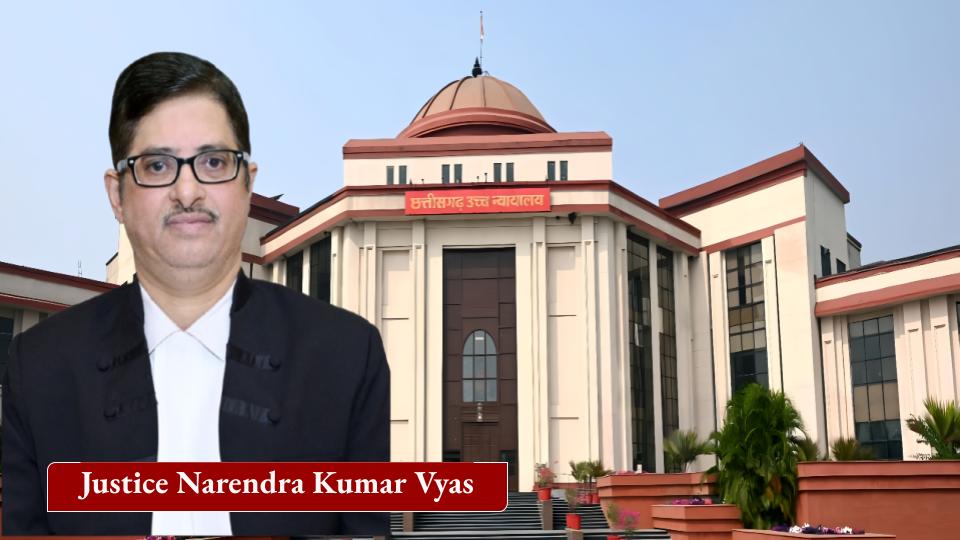
April 16, 2026 : The High Court of Chhattisgarh has partly allowed a criminal appeal, with Justice Narendra Kumar Vyas setting aside a conviction under Section 398 of the Indian Penal Code (IPC) and instead convicting the appellant under Section 392 IPC, while limiting the sentence to the period already undergone.
In CRA No. 1630 of 2000, the Court examined the appeal filed by Praveen Kumar against his conviction by the trial court for robbery while allegedly armed with a deadly weapon. The trial court had sentenced him to seven years of rigorous imprisonment under Section 398/34 IPC.
According to the prosecution, the incident dates back to February 4, 1995, when the complainant, a tailor, was returning home on a bicycle after work. He was intercepted by three individuals who initially asked for directions and later threatened him with a knife, robbing him of a small amount of cash and a wristwatch. The accused fled when they sensed people approaching.
The High Court, however, found a critical gap in the prosecution’s case. It noted that the complainant failed to clearly identify which of the accused had actually used the deadly weapon. The Court emphasized that for a conviction under Section 398 IPC, it must be proved that the specific accused had used or was armed with a deadly weapon during the offence. In this case, such identification was missing, including during the test identification parade.
Relying on established Supreme Court precedents, the Court held that the term “offender” under Section 398 applies only to the individual who actually used the deadly weapon. Since this element was not proved beyond reasonable doubt, the conviction under Section 398 IPC was deemed unsustainable and set aside.
At the same time, the Court found that the core ingredients of robbery were clearly established. The victim’s testimony showed that the accused, along with others, had taken his belongings by putting him in fear of immediate harm. This satisfied the definition of robbery under Section 390 IPC, punishable under Section 392 IPC.
On sentencing, the Court took a lenient view. It noted that the incident occurred over three decades ago, the appellant was about 18 years old at the time, and he had already spent approximately four and a half years in custody. Considering these factors, the Court reduced the sentence to the period already undergone.
With these modifications, the appeal was partly allowed, and the appellant’s bail bonds were discharged.
Case Reference : CRA No. 1630 of 2000, Praveen Kumar vs State of Madhya Pradesh (Now Chhattisgarh); Counsels: For Appellant: Mr. Vidya Bhushan Soni, Advocate; For State: Mr. Krishna Gopal Yadav, Deputy Government Advocate.