News Citation : 2026 LN (HC) 321 | 2026:JHHC:13049
May 1, 2026 : The Jharkhand High Court has dismissed two writ petitions filed by members of the Munjal family challenging government action over a 2.90-acre land parcel in Ranchi, holding that the very foundation of their claim a 1959 permission for transfer of tribal land was legally void.
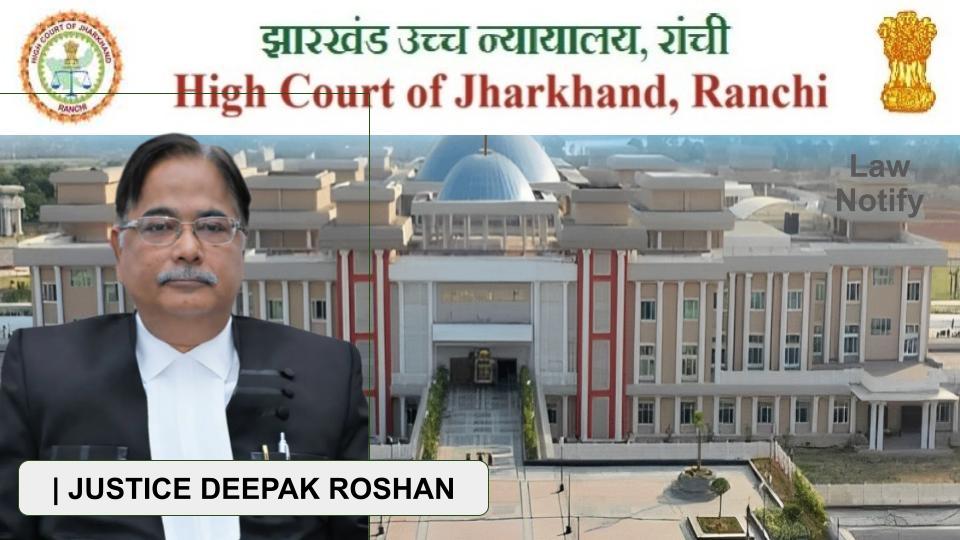
In a detailed judgment delivered on May 1, 2026, Justice Deepak Roshan ruled that the original permission granted by the Deputy Commissioner in 1959 under Section 49 of the Chotanagpur Tenancy (CNT) Act suffered from a “grave jurisdictional error” and amounted to a fraud on the statute. As a result, the Court held that no valid title could flow from such an order, effectively collapsing the petitioners’ entire case.
The dispute centres on land in Booty village, Ranchi, originally recorded in the name of a tribal raiyat, Bipta Pahan. The Munjal family traced their title to a sale deed executed in December 1959 in favour of their predecessor, Jiwan Lal, after obtaining official permission. Over the decades, the family claimed that their possession and title had been affirmed through various legal proceedings and revenue records.
However, the State and private respondents contested this narrative, arguing that the land remained in continuous possession of the original tribal family and that the 1959 transfer was illegal and obtained through misrepresentation. They also relied on revenue enquiries suggesting that the petitioners were never in actual possession of the land.
The High Court agreed with this position, emphasizing that the CNT Act is a protective legislation designed to prevent alienation of tribal land to non-tribals. It held that the phrase “reasonable and sufficient purpose” under Section 49 must be interpreted strictly in line with the statute’s objective. The reasons cited in 1959 such as purchasing bullocks and redeeming mortgaged land did not qualify as valid grounds under the law.
The Court found that the Deputy Commissioner’s order granting permission for transfer lacked the essential jurisdictional foundation and was therefore void ab initio. It observed that when the foundational order itself is invalid, all subsequent proceedings based on it automatically fall.
On this reasoning, the Court refused to quash a 2021 order passed by the State’s Revenue Minister directing restoration of the land to the tribal heirs and annulling the earlier permission. The Court noted that setting aside the 2021 order would effectively revive the illegal 1959 permission, which it declined to do.
At the same time, the Court partly interfered with the 2021 order to the limited extent that it had directed initiation of criminal proceedings against the petitioners. It held that such directions were beyond the jurisdiction of the authority acting under Section 49(5) of the CNT Act and therefore unsustainable.
Rejecting the petitioners’ arguments on limitation, res judicata, and alleged forcible dispossession, the Court concluded that no discretionary relief could be granted under Article 226 of the Constitution, particularly in light of the protective purpose of the CNT Act. With this, both writ petitions were dismissed, bringing a significant setback to the Munjal family’s decades-old claim over the disputed land.
Case Reference : W.P.(C) No. 1510 of 2021 Prakash Munja and Others vs State of Jharkhand and Others with W.P.(C) No. 1791 of 2021 Prakash Munjal and Others vs State of Jharkhand and Others; Counsels: For the Petitioners: Mr. Amar Kumar Sinha, Adv., Mr. Kundan Kr. Ambastha, Adv., Mr. Parth Jalan, Advocate; For the State: Mr. Rajiv Ranjan, A.G., Mr. Piyush Chitresh, AC to A.G.; For the Private Respondents: Mr. Amritansh Vats, Adv., Mr. Shivak A. Pathak, Adv., Mr. Amartya Choudhary, Adv., Mr. Arpan M. Ekka, Advocate, Mr. Ashish Choudhary, Adv.