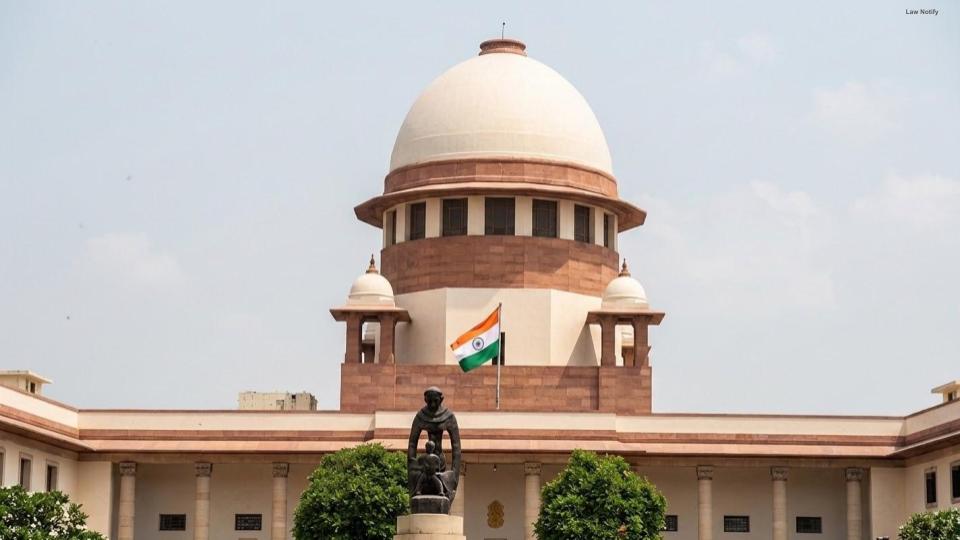
May 13, 2026 : The Supreme Court on Wednesday stayed an interim order of the Madras High Court which had restrained Tamilaga Vettri Kazhagam (TVK) MLA Sreenivasa Sethupathi from participating in the floor test in the Tamil Nadu Legislative Assembly. A Bench comprising Justice Vikram Nath, Justice Sandeep Mehta and Justice Vijay Bishnoi also stayed further proceedings before the High Court in the writ petition filed by DMK leader KR Periakaruppan challenging Sethupathi’s election victory.
The matter was urgently mentioned before Chief Justice of India Surya Kant on Tuesday in light of the impending trust vote in the Tamil Nadu Assembly. Taking note of the urgency, the matter was listed for hearing on Wednesday.
Senior Advocate Abhishek Manu Singhvi, appearing for Sethupathi, argued that the Madras High Court had committed a jurisdictional error by entertaining a writ petition under Article 226 challenging an election result despite the availability of an alternative statutory remedy through an election petition under the Representation of the People Act, 1951. He further questioned the urgency with which the High Court had heard the matter during the weekend.
During the hearing, the Supreme Court orally observed that the High Court itself had acknowledged that an election petition was the appropriate statutory remedy, yet proceeded to entertain the writ proceedings and restrain an elected legislator from voting in the floor test.
Senior Advocate Mukul Rohatgi, appearing for Periakaruppan, defended the High Court’s intervention, contending that the matter involved exceptional circumstances justifying the exercise of extraordinary writ jurisdiction. He submitted that Periakaruppan had contested from Constituency No. 185 Tiruppattur and that a postal ballot cast in his favour had mistakenly been delivered to another constituency bearing a similar name. According to him, if the postal ballot had been counted, the election result would have resulted in a tie.
The Apex Court stayed the operation of the High Court’s interim order and granted time to Periakaruppan to file a counter affidavit. During the proceedings, Singhvi informed the Court that the floor test proceedings were already underway.
On May 7, the Madras High Court had restrained Sethupathi from participating in any floor test, confidence motion, no-confidence motion, trust vote or proceedings testing the numerical strength of the House, pending adjudication of the writ petition filed by Periakaruppan.
Sethupathi had defeated Periakaruppan by a margin of one vote in the Tiruppattur Assembly constituency election. Periakaruppan subsequently approached the High Court alleging that a postal ballot cast in his favour was not counted because it had wrongly been sent to another constituency.
The Division Bench of Justice Victoria Gowri and Justice N Senthilkumar had observed that permitting Sethupathi to vote during the pendency of the dispute could potentially affect the stability of the government and held that the balance of convenience justified restraining his participation in the floor test.
The High Court clarified that the interim order did not amount to setting aside Sethupathi’s election and did not confer any right on Periakaruppan to be declared elected. It also directed preservation of all records relating to the counting process conducted on May 4, 2026, including consolidated counting abstracts, statutory forms, round-wise counting sheets, postal ballot records, rejected postal ballot covers, videographic footage and related electronic records.
The High Court further ordered that if any postal ballot relating to Constituency No. 185 Tiruppattur had been received at Constituency No. 50 Tiruppattur, it must be separately identified, sealed and preserved without tampering.
At the same time, the High Court clarified that its order should not be construed as directing recounting, reopening of ballot papers, revalidation of rejected postal ballots or interference with the declared election result. The rights and remedies available to parties under the Representation of the People Act, 1951 were also kept open.
The Election Commission of India submitted before the High Court that it was only the statutory authority responsible for maintaining election records and administering the electoral process, and not the adjudicatory forum to determine the rightful winner of the election. It argued that once the result was declared, the Returning Officer became functus officio and any adjudication concerning disputed postal ballots would require reopening sealed records through a trial-like evidentiary process.