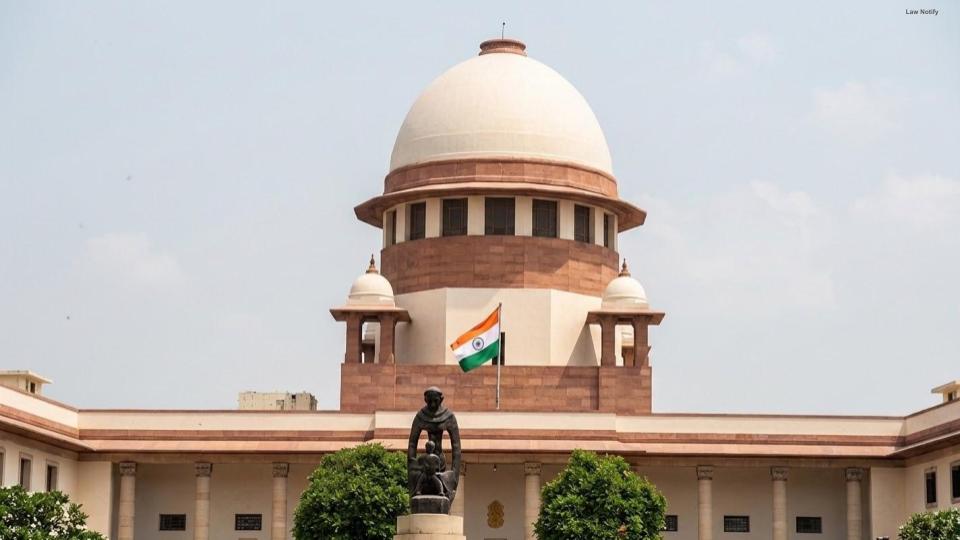
May 22, 2026 : The Supreme Court on Friday recalled portions of its earlier order that had barred three academics involved in drafting a controversial NCERT Class VIII textbook chapter on the judiciary and corruption from participating in academic activities related to curriculum development.
A bench comprising Chief Justice of India Surya Kant, Justice Joymalya Bagchi and Justice Vipul M Pancholi modified its March 11 order and withdrew the direction asking the Union government, State governments, universities and educational institutions to disassociate themselves from Professor Michel Danino, Suparna Diwakar and Alok Prasanna Kumar in all academic engagements.
The Court clarified that although it continued to consider the contents of the chapter inappropriate and lacking balance, the explanations submitted by the three academics justified reconsideration of the earlier directions issued against them. The bench also recalled its previous observation suggesting that the authors had deliberately or knowingly misrepresented facts, noting that the clarification furnished during the proceedings warranted withdrawal of those remarks.
The Court observed that corrective steps had already been initiated by the Union government through the constitution of an expert committee to review and revise the curriculum concerning the judiciary and constitutional studies. However, the bench left it open to the Union government, State governments and other competent authorities to independently decide whether the three academics should be associated with future academic assignments, without being influenced by the Court’s earlier observations.
The controversy arose after objections were raised over portions of the NCERT Class VIII textbook “Exploring Society: India and Beyond,” particularly a chapter discussing the judiciary and corruption. Taking suo motu cognisance of media reports earlier this year, the Supreme Court had observed that the chapter failed to present a balanced understanding of the constitutional role of the judiciary and undermined institutional dignity.
Following the proceedings, NCERT acknowledged an error of judgment in drafting the chapter and informed the Court that the disputed portions would be withdrawn and revised after fresh consultation. On February 26, the Supreme Court restrained further production and circulation of the textbook, after which NCERT formally withdrew the publication from circulation.
NCERT later informed the Court that the chapter had been drafted by Professor Michel Danino with assistance from Suparna Diwakar and Alok Prasanna Kumar.
In its March 11 order, the apex court had directed that the three experts should not be associated with curriculum development or textbook finalisation processes in India. The Court had also ordered the constitution of a committee of domain experts, preferably including a former judge, an academic and a legal practitioner, to review the curriculum relating to legal education and constitutional studies.
Pursuant to the Court’s directions, a three-member expert committee comprising former Supreme Court judge Indu Malhotra, Senior Advocate K K Venugopal and Professor Prakash Singh, Vice-Chancellor of Hemvati Nandan Bahuguna Garhwal University, was constituted to examine and finalise the legal studies curriculum in coordination with the National Judicial Academy.
During Friday’s hearing, Solicitor General Tushar Mehta, appearing for the Union government, submitted that the government did not intend to associate with the experts involved in drafting the disputed chapter. He also referred to concerns regarding similar content in other NCERT textbooks, including the use of cartoons in legal and constitutional subjects for school students.
Senior Advocate Shyam Divan, appearing for Professor Danino, argued that the earlier directions had been passed without granting the academics an opportunity of hearing and had serious professional consequences. Senior Advocate Gopal Sankaranarayanan, appearing for Alok Prasanna Kumar, contended that there was no deliberate or malicious intent behind the drafting of the chapter and submitted that the controversy had escalated after selective media reporting of isolated extracts.
The bench observed that its concern was not whether the textbook portrayed the judiciary positively or negatively, but whether the material presented a balanced and constitutionally informed perspective. The Court noted that the chapter focused disproportionately on allegations of corruption while failing to adequately discuss constitutional supremacy, access to justice, legal aid and the broader institutional role of the judiciary.