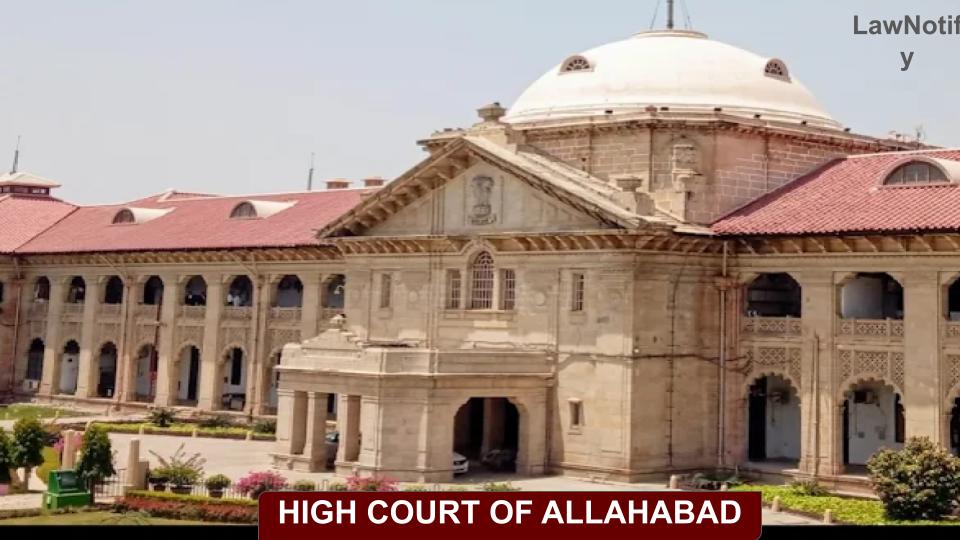
June 4, 2026 : An application has been moved before the Allahabad High Court challenging orders of courts in Agra that refused to appoint an Advocate-Commissioner to inspect the Taj Mahal and carry out photography and videography in a pending civil suit claiming that the monument is an ancient Hindu temple known as “Tejo Mahalaya.”
The writ petition has been filed on behalf of the deity Lord Sri Agreshwar Mahadev Nagnatheswar Virajman through its next friend, Advocate Hari Shankar Jain, along with several devotees. The respondents include the Union of India, the Archaeological Survey of India (ASI) and other concerned authorities.
The dispute originates from a civil suit instituted in 2015 before the Civil Judge (Senior Division), Agra. In the suit, the plaintiffs seek a declaration that the Taj Mahal was originally a Hindu temple dedicated to Lord Shiva under the name “Tejo Mahalaya.” They have also sought permission for Hindus to perform darshan and worship within the monument premises, contending that such a right is protected under Article 25 of the Constitution.
During the pendency of the suit, the plaintiffs filed an application in 2019 under the Code of Civil Procedure, 1908, requesting the appointment of an Advocate-Commissioner to inspect the monument and document its architectural, structural and physical features through photographs and videography. According to the plaintiffs, such evidence is necessary for a proper adjudication of the issues involved in the case.
The trial court, however, rejected the application. It observed that the plaintiffs had failed to produce revenue records, including khasra and khatauni, to establish the exact details of the property. The court also noted discrepancies between the boundaries and area described by the plaintiffs and the documents relied upon by the defendants.
The plaintiffs challenged the order before the Additional District Judge, Agra, by filing a civil revision. However, in April this year, the revisional court dismissed the revision as not maintainable.
Aggrieved by both orders, the petitioners have now approached the Allahabad High Court, arguing that the courts below committed patent illegality and material irregularity by rejecting the application on grounds that were irrelevant to the purpose of appointing an Advocate-Commissioner. According to the petition, there is no dispute regarding the identity of the suit property, as the Taj Mahal is a globally recognized protected monument. Therefore, the absence of revenue records could not have been a valid reason to reject the request for a local inspection.
The petition reiterates the historical, archaeological and architectural claims made in the original civil suit. It alleges that the structure was constructed in 1155-56 AD by Raja Paramardi Dev as a temple dedicated to Lord Shiva, known as “Tejo Mahalaya.” It further claims that the property later came under the control of Raja Maan Singh and subsequently Raja Jai Singh of Jaipur before Mughal emperor Shah Jahan allegedly took possession of it and converted it into a mausoleum by incorporating Islamic features.
The petitioners further claim that more than 109 archaeological, historical and architectural features indicate that the monument was originally a Hindu temple. Among the features cited are the lotus-petal design surrounding the marble dome, the kalash atop the dome and the existence of a structure recorded by the ASI as a gaushala. According to the petition, a gaushala forms an integral part of a Hindu temple complex rather than a Muslim mausoleum.
The plea also alleges that several portions of the Taj Mahal remain locked and inaccessible to the public. It further contends that while the ASI permits Muslims to offer Friday namaz at the monument, Hindus are denied the opportunity to perform worship, which the petitioners argue is contrary to law.
According to the petitioners, the structural, archaeological and architectural features of the monument, including the locked portions, cannot be effectively proved through oral evidence alone. They submit that an objective report prepared by a court-appointed Advocate-Commissioner through photography and videography is essential for the fair adjudication of the pending civil suit.
The petition also points out that since the Taj Mahal is a protected monument under the management and control of the ASI, the plaintiffs do not have an independent right to conduct photography or videography inside the monument. Therefore, they argue that only a court-appointed Advocate-Commissioner can legally inspect the premises, document the relevant physical features and place the material before the trial court.
The petitioners have sought quashing of the orders passed by the Civil Judge (Senior Division), Agra, and the Additional District Judge, Agra, along with a direction to the trial court to reconsider the application for appointment of an Advocate-Commissioner on its merits and in accordance with law.
Pending disposal of the writ petition, the petitioners have also sought interim directions to the Director General of the ASI to undertake photography of the Taj Mahal from both the interior and exterior in the presence of the petitioners and submit the photographs before the High Court to facilitate effective adjudication of the matter.
The writ petition is scheduled to be taken up for hearing by the Allahabad High Court on Monday.