News Citation : 2026 LN (HC) 366
The High Court of Chhattisgarh has set aside recovery orders issued against retired officials of the Water Resources Department, ruling that financial liability cannot be imposed on government employees, particularly after retirement, without conducting a proper departmental inquiry in accordance with law.
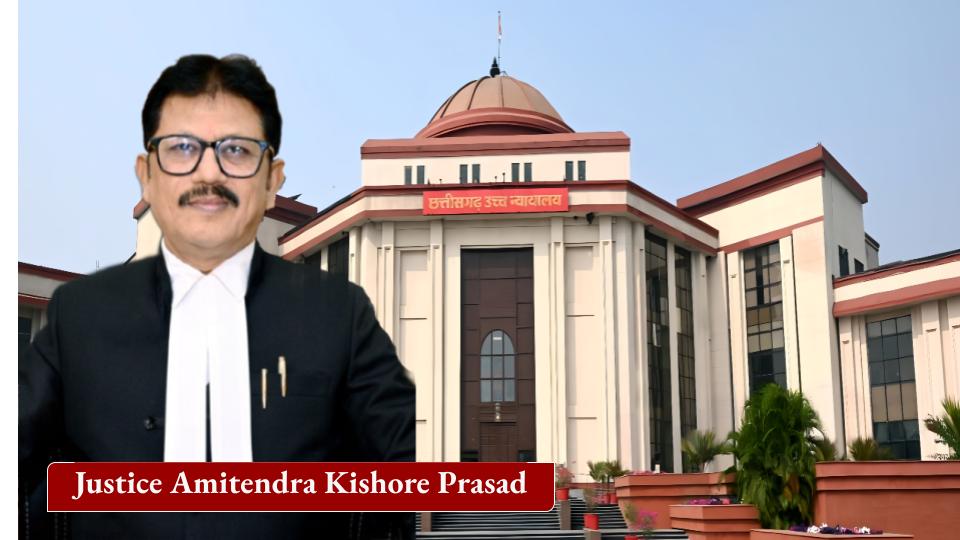
In a significant judgment delivered on June 15, 2026, Justice Amitendra Kishore Prasad allowed a batch of writ petitions filed by Prakash Chandra Sahu and Kailash Kumar Shrivastava, who had challenged orders directing recovery of Rs. 5.13 lakh each from their pensionary benefits on allegations of excess expenditure incurred during MGNREGA works in Kabirdham district.
The dispute arose from repair works carried out during 2016-17 at Sari Dam in Gram Panchayat Talpur under the Mahatma Gandhi National Rural Employment Guarantee Scheme (MGNREGA). Departmental authorities later alleged that an expenditure of approximately Rs. 11.42 lakh had been incurred beyond the sanctioned amount. Based on an internal inquiry, liability was apportioned among departmental officers and recovery proceedings were initiated.
The petitioners argued that the alleged excess expenditure was not attributable to them and that the works had been executed with approvals from competent authorities. They further alleged that certain official records, including measurement books and vouchers, had been manipulated through misuse of signatures and seals by another officer. According to the petitioners, despite raising these concerns before departmental authorities, no meaningful inquiry was conducted into their allegations.
The State defended the recovery action by contending that a departmental inquiry had revealed negligence on the part of the concerned officers. Authorities maintained that excess expenditure beyond sanctioned limits had caused financial loss to the State and justified recovery from the responsible officials, including deductions from gratuity and other retirement benefits.
After examining the records, the High Court found that the proceedings relied upon by the State did not amount to a regular departmental inquiry under the Chhattisgarh Civil Services (Classification, Control and Appeal) Rules, 1966. The Court noted that no charge-sheet had been issued, no formal charges were framed, no witnesses were examined and the petitioners were not granted an opportunity to cross-examine witnesses or effectively defend themselves.
The Court observed that “the so-called inquiry remains in the nature of a preliminary fact-finding exercise” and therefore could not legally form the basis for imposing pecuniary liability. It further held that the authorities had mechanically distributed liability among officers without recording specific findings regarding the individual role, misconduct or negligence of each officer.
Emphasizing the importance of procedural safeguards, the Court reiterated that recovery proceedings carrying civil consequences must comply with principles of natural justice. It held that any action resulting in financial liability requires adherence to due process, including a lawful departmental inquiry and a reasonable opportunity of hearing.
The judgment extensively referred to several Supreme Court precedents dealing with disciplinary proceedings, judicial review and natural justice. The Court relied upon recent rulings emphasizing that preliminary inquiries cannot substitute regular disciplinary proceedings and that recovery from retired employees without following prescribed procedures is legally unsustainable.
A particularly significant aspect of the ruling concerns pension and gratuity. The High Court reiterated the settled legal principle that pensionary benefits are not a bounty but a vested right of retired employees. It held that deductions from pension or gratuity cannot be made merely on the basis of preliminary findings or administrative correspondence and must be supported by a valid inquiry culminating in findings of misconduct.
The Court concluded that the decision-making process adopted by the authorities suffered from procedural impropriety, arbitrariness and violation of natural justice. It found that the recovery orders were unsupported by individualized findings and failed to consider the specific defenses raised by the petitioners. Consequently, the Court interfered under Article 226 of the Constitution and quashed the impugned recovery proceedings.
The ruling is expected to have wider implications for government departments across India, particularly in cases involving post-retirement recoveries from pension and gratuity. The judgment reinforces the principle that administrative authorities cannot impose financial liability on public servants without conducting a legally compliant disciplinary process and ensuring adherence to constitutional guarantees of fairness and due process.
Case Reference: Prakash Chandra Sahu v. State of Chhattisgarh & Others (WPS No. 6696/2021 & WPS No. 3110/2023) along with Kailash Kumar Shrivastava v. State of Chhattisgarh & Others (WPS No. 248/2021)