News Citation : 2026 LN (HC) 382
June 16, 2026 : In a significant ruling on the scope of judicial interference in criminal prosecutions, the Chhattisgarh High Court has declined to quash an FIR, charge-sheet and subsequent criminal proceedings against a businessman accused of generating bogus invoices and facilitating wrongful input tax credit under the Chhattisgarh Value Added Tax Act, 2005. The Court held that the allegations disclosed a prima facie case of cheating and forgery and that disputed factual issues must be examined during trial rather than in proceedings seeking quashing of criminal prosecution.
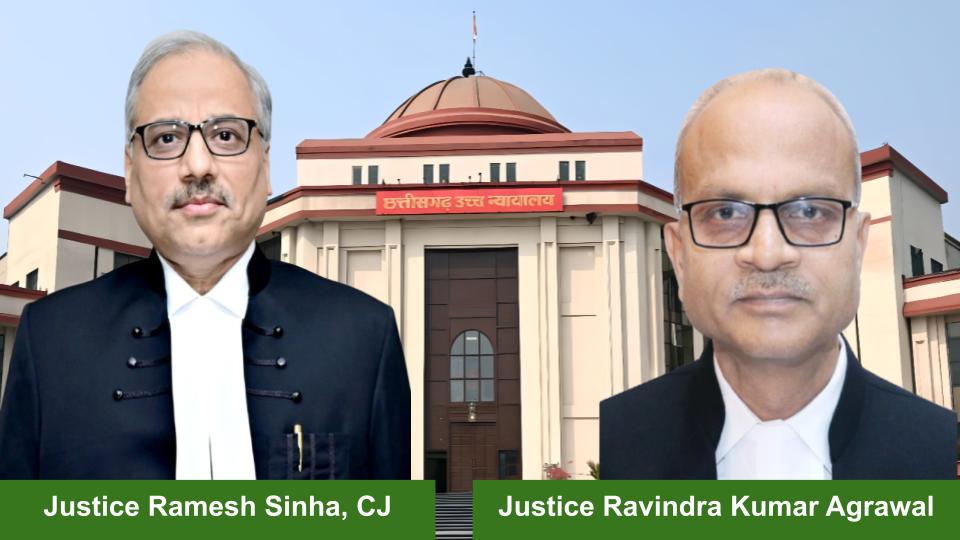
The Division Bench comprising Chief Justice Ramesh Sinha and Justice Ravindra Kumar Agrawal dismissed a petition filed under Section 528 of the Bharatiya Nagarik Suraksha Sanhita, 2023, by Nishant Sahu, who had sought quashing of FIR No. 361/2014 registered at Civil Lines Police Station, Bilaspur, along with the charge-sheet, cognizance order and charges framed against him.
According to the prosecution, the petitioner, proprietor of M/s Sai Nath Enterprises, had obtained registration under the Chhattisgarh Value Added Tax Act for trading in coal and coke. During scrutiny of departmental records and online returns, authorities allegedly discovered a major discrepancy between sales disclosed in VAT returns and transactions reflected in departmental databases. While sales of approximately ₹47.37 lakh were reportedly declared in returns, departmental records allegedly reflected transactions worth about ₹3.56 crore. Investigators alleged that bogus sales invoices were generated, enabling various dealers to claim wrongful input tax credit and causing a loss of nearly ₹17.81 lakh to the State exchequer.
The petitioner argued that the dispute was purely fiscal in nature and governed exclusively by the Chhattisgarh Value Added Tax Act, which contains its own mechanism for assessment, reassessment, penalties and prosecution. It was contended that criminal provisions under Sections 420 and 467 of the Indian Penal Code had been wrongly invoked. The petitioner further submitted that no reassessment proceedings under Section 22 of the VAT Act had been undertaken, that mandatory sanctions were absent, and that the investigation had taken nearly eleven years to culminate in a charge-sheet, violating his constitutional right to a speedy trial under Article 21 of the Constitution.
The defence also claimed that no forged document had been recovered or attributed to the petitioner and that witness statements pointed towards another accused, Sonu alias Piyush Singh, as the person allegedly responsible for operating firms and generating questionable invoices. It was further argued that any tax liability had already been discharged and that continuation of criminal proceedings amounted to abuse of the legal process.
Opposing the petition, the State maintained that extensive investigation had been conducted, including examination of tax department records, banking transactions and witness statements. The prosecution alleged that the petitioner and the co-accused acted together to create fictitious transactions that enabled wrongful tax benefits and caused financial loss to the government. The State also explained that the delay in filing the charge-sheet was attributable to the petitioner allegedly remaining untraceable for several years before being apprehended in Pune in 2025, while the co-accused continued to be absconding.
While examining the matter, the High Court relied on several Supreme Court decisions, including Neeharika Infrastructure Pvt. Ltd. v. State of Maharashtra and Pradeep Kumar Kesharwani v. State of Uttar Pradesh, reiterating that the power to quash criminal proceedings is extraordinary and must be exercised sparingly. The Court emphasized that at the quashing stage, it is not required to assess the truthfulness of allegations or conduct a mini-trial. The only consideration is whether the allegations and material collected during investigation disclose the commission of cognizable offences.
Rejecting the petitioner’s argument that the matter was purely a tax dispute, the Court observed that the allegations extended beyond a simple case of tax deficiency. The Bench noted that the prosecution case involved allegations of bogus invoices, fictitious transactions and fraudulent conduct resulting in wrongful gain and loss to public revenue. The Court observed that merely because a transaction has civil, commercial or fiscal consequences does not bar criminal prosecution where the ingredients of criminal offences are prima facie disclosed.
Addressing the petitioner’s reliance on witness statements allegedly exonerating him, the Court held that such contentions constituted matters of defence and could only be examined during trial. It further ruled that questions regarding applicability of the VAT Act, the necessity of reassessment proceedings, sanction requirements, alleged payment of tax dues and the role of the co-accused involve disputed questions of fact and law that cannot be conclusively determined in proceedings under Section 528 BNSS.
The Bench also declined to accept the argument that delay in investigation by itself justified quashing the prosecution. Referring to the prosecution’s explanation that the petitioner had remained unavailable for a considerable period after registration of the crime, the Court held that delay alone cannot nullify criminal proceedings when the material on record prima facie indicates commission of cognizable offences.
In a key observation, the Court stated that “the allegations levelled against the petitioner, if taken at their face value and accepted as correct for the limited purpose of the present proceedings, disclose a prima facie case warranting adjudication by the competent criminal Court.” It further held that “the High Court, while exercising its inherent jurisdiction, does not function as a trial Court and cannot undertake a roving enquiry into the truthfulness, reliability or admissibility of the material collected during investigation.”
Finding no exceptional circumstance warranting intervention, the High Court concluded that the case did not fall within the recognized categories permitting quashing of criminal proceedings at the threshold. Consequently, the petition was dismissed, and the FIR, charge-sheet, cognizance order and charges framed against the petitioner were allowed to stand. The Court clarified that its observations were confined to the quashing proceedings and would not influence the trial court’s independent assessment of evidence.
The ruling reinforces the principle that criminal proceedings involving allegations of fraudulent tax transactions, forged documentation and wrongful financial gain cannot ordinarily be halted merely because parallel remedies exist under fiscal statutes. The judgment is likely to be cited in future cases involving attempts to quash prosecutions arising from alleged tax evasion and fraudulent commercial transactions at the preliminary stage.
Case Reference : Nishant Sahu v. State of Chhattisgarh