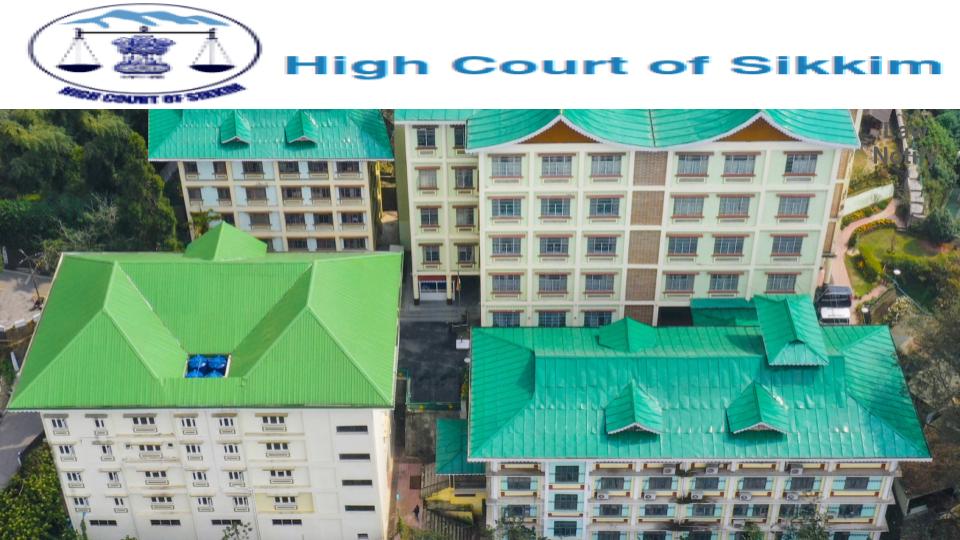
July 11, 2026 : The Sikkim High Court has upheld the conviction of a 42-year-old man for sexually assaulting a 16-year-old schoolgirl and abetting her suicide, holding that the prosecution established an unbroken chain of evidence proving that the accused’s actions drove the victim to take her own life.
A Division Bench comprising Chief Justice A. Muhamed Mustaque and Justice Bhaskar Raj Pradhan dismissed the appeal filed by convict Chewang Sherpa against his 2023 conviction under the Protection of Children from Sexual Offences (POCSO) Act and the Indian Penal Code (IPC). The Court observed that the prosecution’s case was conclusive and left no reasonable hypothesis of innocence.
The case relates to an incident on August 20, 2021, during the Covid-19 lockdown. The victim, a Class XII student, had gone to her school to submit examination papers. While returning home, she accepted a ride from the accused, who belonged to her village. According to the prosecution, heavy rain forced them to take shelter near a monastery, where the accused sexually assaulted the minor.
After returning home, the victim wrote a detailed account of the assault in her school notebook before dying by suicide. Rejecting the appellant’s challenge to the investigation and the authenticity of the note, the High Court held that the victim’s written account qualified as a valid dying declaration under Section 32 of the Indian Evidence Act.
The Bench observed that the victim found the accused’s conduct, including the sexual assault, so humiliating, degrading and intolerable that she experienced an overwhelming sense of defilement and was unable to face anyone, ultimately leading her to end her life.
While affirming the conviction, the High Court modified the sentence by setting aside the separate three-year imprisonment imposed under Section 354A of the IPC for sexual harassment. Referring to Section 42 of the POCSO Act and Section 71 of the IPC, the Court held that where the same act attracts punishment under multiple statutory provisions, only the more severe punishment should be imposed. It accordingly directed that the remaining sentences would run concurrently.
The Court also expressed serious concern over the effectiveness of the State’s prison rehabilitation system. It noted that Sherpa had previously been convicted under Section 458 of the IPC and observed that his subsequent involvement in a far more heinous offence raised questions about the rehabilitation measures at the State Central Prison in Rongyek.
In a significant part of the judgment, the Bench urged the State Government to prioritise the mental health of children, particularly young girls dealing with trauma. Referring to the victim’s suicide note, the Court said it was deeply disturbed by the emotional distress reflected in her writing and called for a structured, scientific approach to child mental health interventions.
Emphasising that a healthy mind is essential for the development of both the State and the nation, the High Court directed the State to formulate concrete measures for promoting children’s mental well-being across rural and urban areas. It also called for a scientific evaluation of existing mental health programmes to ensure that they effectively address the needs of children.