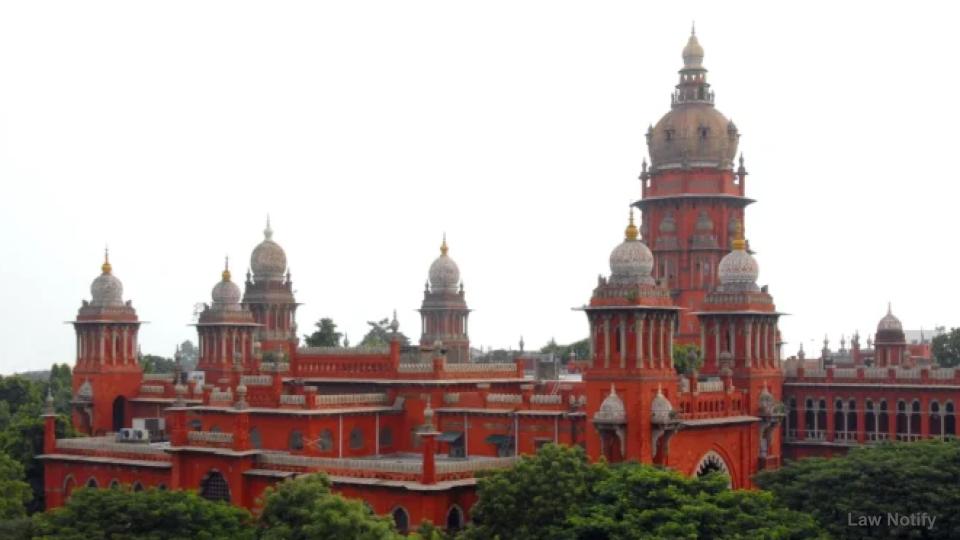
July 11, 2026 : The Madras High Court has restrained the Election Commission of India (ECI) from issuing notifications for bye-elections to five vacant Assembly constituencies in Tamil Nadu until July 31, holding that significant constitutional and legal questions must first be examined in view of pending election petitions challenging the victories of the resigned legislators.
A Division Bench comprising Chief Justice Sushrut Arvind Dharmadhikari and Justice G. Arul Murugan passed the interim order while hearing a Public Interest Litigation (PIL) filed by Tirunelveli-based advocate K. Venkatachalapathy.
The vacancies arose after the resignations of the MLAs representing Tiruchi East, Perundurai, Ambasamudram, Viralimalai and Karur constituencies. Tamil Nadu Chief Minister C. Joseph Vijay vacated the Tiruchi East seat after choosing to retain the Perambur constituency, while former AIADMK legislators S. Jayakumar, Esakki Subbaiah, C. Vijayabaskar and M.R. Vijayabaskar resigned from the Assembly after joining the ruling Tamilaga Vettri Kazhagam (TVK).
The petitioner argued that these vacancies cannot be treated as “clear vacancies” under Section 151A of the Representation of the People Act, 1951, because election petitions against the returned candidates are already pending before the High Court. Those petitions seek not only to invalidate the elections but also declarations that the respective election petitioners should be recognised as the duly elected representatives.
Relying on Supreme Court precedents, including Sanjeevayya v. Election Commission of India (1967), Election Commission of India v. Telangana Rashtra Samithi (2011), and Pramod Laxman Gudadhe v. Election Commission of India (2018), the petitioner contended that conducting bye-elections before deciding the election petitions would be legally impermissible.
The High Court observed that if a pending election petition ultimately results in another candidate being declared the validly elected MLA after a by-election has already been conducted, it could lead to two individuals simultaneously claiming the right to represent the same constituency. According to the Bench, such a situation would create constitutional complications, compromise the integrity of the electoral process and unnecessarily burden the public exchequer.
Accordingly, the Court restrained the Election Commission from issuing any notification for bye-elections to the five constituencies until the next date of hearing.
Appearing for the Tamil Nadu government, Advocate General Vijay Narayan argued that a distinction must be made between cases where an MLA resigns before an election petition is filed and those where the resignation follows the institution of such proceedings. He submitted that once a resignation is accepted, the seat becomes vacant and, if no election petition existed at that time, a subsequently filed petition should not prevent the Election Commission from performing its statutory duty of holding a by-election. He also emphasized that voters should not remain without representation for an extended period.
Senior counsel G. Masilamani, representing Chief Minister C. Joseph Vijay, challenged the maintainability of the PIL and questioned the petitioner’s locus standi. He argued that the petition was premature because the Election Commission had not yet taken any final decision or issued a notification for conducting the bye-elections.
Counsel appearing for the Election Commission informed the Court that the Commission had not yet received notices in several election petitions and was unaware of the precise reliefs sought. It was further submitted that questions regarding the maintainability of certain election petitions and the removal of procedural defects were still pending before the High Court Registry.
Rejecting the preliminary objection on locus standi, the Division Bench held that issues affecting the fairness and integrity of the democratic process cannot be rejected on narrow technical grounds. The Court observed that matters concerning electoral purity deserve judicial examination even when raised through a public interest litigation.
Holding that the legal consequences of pending election petitions on vacancies created by resignations require detailed consideration, the Bench directed all respondents to file their counter-affidavits by July 31. The matter has been listed for further hearing on that date, and the interim restraint on the Election Commission from notifying the bye-elections will continue until then.