News Citation : 2026 LN (HC) 251 | 2026:CGHC:16927-DB
April 13, 2026 : The Chhattisgarh High Court has ruled that merely emerging as the lowest bidder in a government tender does not give a contractor any enforceable right to be awarded the work, especially when authorities cancel the process in line with a broader policy shift aimed at public interest.
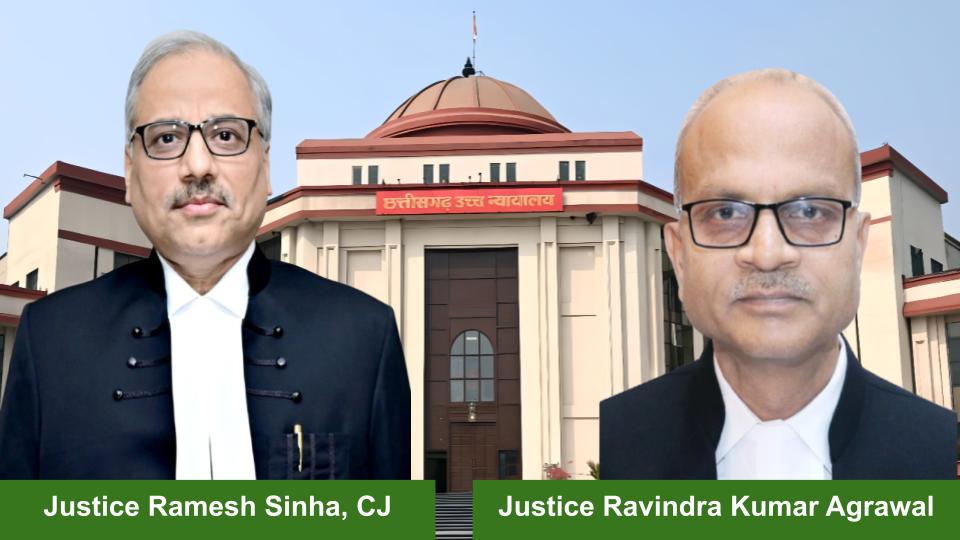
In a judgment delivered on April 13, 2026, a Division Bench comprising Chief Justice Ramesh Sinha and Justice Ravindra Kumar Agrawal dismissed a writ petition filed by M/s Global Services, a Raipur-based firm.
The dispute arose from a tender issued by the Municipal Council, Janjgir-Naila, for the supply of manpower. The petitioner had participated in the bidding process, met all eligibility requirements, and was declared the lowest (L-1) bidder after technical and financial evaluation. Despite this, no work order was issued.
Instead, the municipal authorities cancelled the tender in March 2026, citing new government directives requiring procurement through the Government e-Marketplace (GeM) portal rather than the state’s e-procurement system. The firm challenged this decision, arguing that the cancellation was arbitrary and that the tender process had already concluded in its favour.
The petitioner contended that applying later-issued administrative instructions to an already completed tender amounted to an impermissible retrospective action. It also argued that being declared L-1 created a legitimate expectation of contract award, especially after it had mobilised resources in anticipation of the work order.
Rejecting these arguments, the High Court held that participation in a tender process, even as the lowest bidder, does not create a vested or enforceable right unless a formal contract is concluded. The Bench emphasised that issuance of a work order remains within the discretion of the tendering authority.
The Court further noted that the cancellation was not arbitrary but stemmed from a policy decision to standardise procurement through the GeM portal, aimed at improving transparency, uniformity, and accountability in public procurement. Such policy choices, it observed, fall within the executive domain and are not ordinarily subject to judicial interference.
Addressing the argument of retrospective application, the Court clarified that the decision did not invalidate any concluded contract but merely aligned the procurement process with updated policy requirements. In such circumstances, the timing of the policy change did not render the cancellation illegal.
On the issue of legitimate expectation, the Bench reiterated that such a doctrine cannot override public interest or bind authorities to proceed with a tender that conflicts with revised policy frameworks. It also found no evidence of mala fides, arbitrariness, or procedural irregularity in the decision-making process.
Reaffirming settled principles of judicial restraint in contractual matters, the Court held that its role under Article 226 of the Constitution is limited to reviewing the decision-making process, not the merits of administrative or policy decisions.
Finding no legal infirmity in the cancellation, the Court dismissed the petition and declined to direct issuance of a work order in favour of the petitioner.
Case Reference : WPC No. 1714 of 2026, M/s Global Services (Proprietorship Firm) v. State of Chhattisgarh; Counsel for Petitioner: Mr. Rohit Sharma, Advocate; for Respondent-State: Mr. Priyank Rathi, Government Advocate; for Respondent No. 3: Mr. Shikhar Shukla, Advocate.