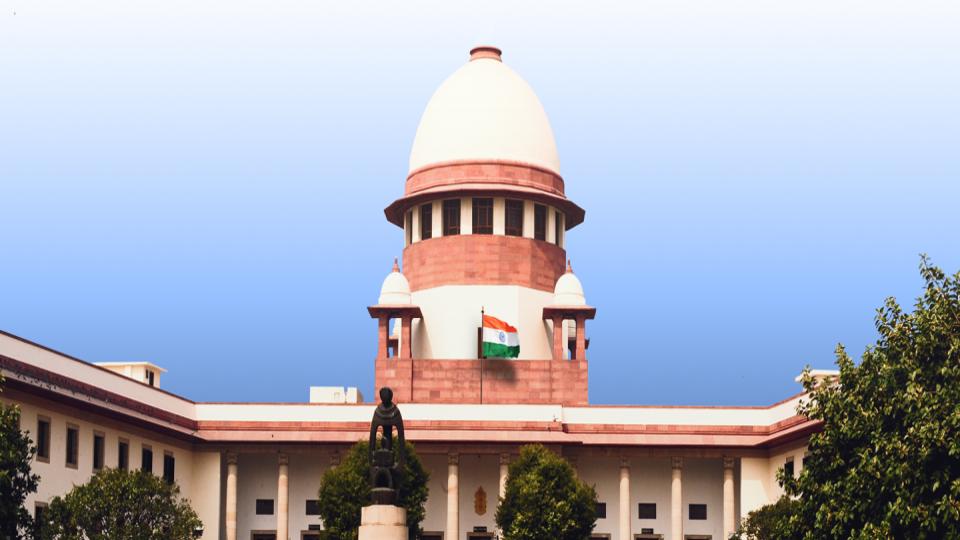
May 4, 2026 : The Supreme Court of India has issued notice to the Union of India and all State Governments in a batch of writ petitions challenging the constitutional validity of the Transgender Persons (Protection of Rights) Amendment Act, 2026. The Court has also directed that the matter be placed before a larger Bench of three judges for authoritative adjudication.
The Bench comprising Chief Justice Surya Kant and Justice Joymalya Bagchi recorded the seriousness of the issues raised, particularly the legislative shift from self-identification of gender to a system of medical and administrative certification. The Court ordered:
“Issue notice. Returnable in four weeks. Notice on behalf of Union of India is accepted. Notice to all the States and Union Territories. Matter may be listed before a 3-Judge bench as considered by the Chief Justice of India.”
The petitions challenge the Amendment Act as unconstitutional and ultra vires, alleging that it effectively nullifies the landmark ruling in NALSA v. Union of India, which recognized the fundamental right to self-perceived gender identity under Article 21.
Senior Advocate A.M. Singhvi, appearing for the petitioners along with Senior Advocate Arundhati Katju, argued that the Amendment dismantles the core principle of self-identification and replaces it with a regime of “medical and bureaucratic gatekeeping.” He contended that while Parliament may remove the basis of a judgment, it cannot directly nullify it without addressing its underlying reasoning.
Justice Bagchi, however, observed that the issue must be tested within the framework of Article 21, noting that the Amendment alters the legal foundation upon which the NALSA judgment was rendered.
Singhvi further submitted that the law creates practical barriers for transgender persons, categorizing affected individuals into two groups: those with intersex variations and those whose gender identity is rooted in psychological and lived experience. He argued that the Amendment conflates these categories while simultaneously denying both groups the autonomy to self-identify.
It was also contended that the law has had immediate adverse consequences. Hospitals are allegedly refusing to proceed with gender-affirming procedures without prior approval from state-sanctioned medical boards, and individuals undergoing hormone therapy have faced abrupt discontinuation of treatment.
Solicitor General Tushar Mehta, representing the Union, responded that the Amendment aims to regulate misuse and prevent coercive or forced gender reassignment practices.
The petitions seek multiple reliefs, including:
- A declaration that the Amendment Act is unconstitutional for violating Articles 14, 15, 19, and 21.
- Invalidation of specific amended provisions, including Sections 2(k), 6(1), 7(1), 7(1A), 16, and 18.
- Recognition of self-identification of gender as a non-negotiable fundamental right.
- Protection of identity certificates issued under the 2019 Act prior to the Amendment.
- Directions for comprehensive legislation aligned with constitutional principles and international standards such as those under the ICCPR, ICESCR, and UDHR.
- Implementation of reservation for transgender persons in education and public employment as envisaged in NALSA.
The lead matter, titled Laxmi Narayan Tripathi v. Union of India, brings into focus a significant constitutional question: whether the State can condition gender identity on medical certification, thereby limiting the autonomy recognized by prior judicial precedent.
The 2026 Amendment marks a substantial shift from the 2019 framework by mandating that a Medical Board examine and recommend applicants before issuance of gender identity certificates. It also introduces reporting obligations for hospitals conducting gender-affirming procedures, raising concerns about privacy, surveillance, and bodily autonomy.
The matter is now set for detailed consideration by a three-judge Bench.
Case Reference : Laxmi Narayan Tripathi v. Union of India and other