News Citation : 2026 LN (HC) 342 | 2026:CGHC:20929-DB
May 5, 2026 : The High Court of Chhattisgarh has dismissed two first appeals filed by M/s Goyal Material Suppliers in a long-running land possession dispute from Raipur district, holding that a plaintiff cannot seek possession of disputed immovable property without first seeking declaration of title when ownership itself is under challenge. The Division Bench also refused to admit additional evidence at the appellate stage, observing that the plaintiffs had failed to produce the original sale deed during trial despite having ample opportunity.
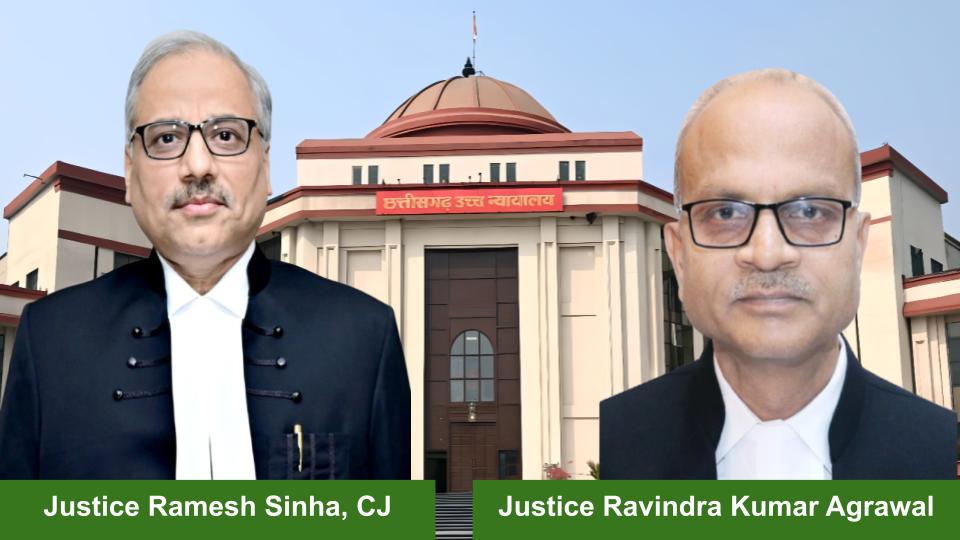
Chief Justice Ramesh Sinha and Justice Ravindra Kumar Agrawal upheld the trial court’s decision dismissing the plaintiffs’ suit for vacant possession, damages and permanent injunction, while also affirming a partial decree in favour of the defendant protecting his possession over four dismil of land where his house was situated.
The dispute arose from agricultural land situated at village Sasaholi in Tilda tehsil of Raipur district. According to the plaintiffs, they had purchased 0.80 acre, equivalent to 80 dismil of land, through a registered sale deed executed on April 15, 1994. They alleged that after a demarcation exercise conducted in 1997, it was discovered that defendant Prahlad Dewangan was occupying four dismil of the purchased land and had constructed a hutment there.
The plaintiffs initially approached revenue authorities under Section 250 of the Chhattisgarh Land Revenue Code, 1959, seeking removal of the alleged encroachment. Although the Tehsildar rejected the application in 1999, the plaintiffs succeeded before the Sub-Divisional Officer and later before the Commissioner and Board of Revenue. However, in 2014, the High Court set aside the favourable revenue orders and clarified that the plaintiffs could not invoke Section 250 proceedings for such relief, leaving them free to pursue appropriate civil remedies.
Following the High Court’s earlier order, the plaintiffs instituted a civil suit seeking vacant possession and injunction. The defendant contested the suit by claiming that the land in question was ancestral property received in family partition and that he was legally entitled to alienate only 65 dismil, not the entire 80 dismil mentioned in the sale deed. He further claimed that the plaintiffs had taken advantage of his alleged mental illness during the early 1990s and procured execution of the sale deed beyond his lawful share.
The defendant also argued that his family had been residing on a portion of the land for over four decades and that his house stood on four dismil of the disputed property. In a counterclaim filed under Order VIII Rule 6 of the Code of Civil Procedure, 1908, he sought permanent injunction restraining the plaintiffs from interfering with his possession.
After examining oral and documentary evidence, the trial court dismissed the plaintiffs’ suit and partly allowed the counterclaim. The court found that although the defendant could not establish ownership over the entire 15 dismil claimed by him, he had proved possession over four dismil of land where his hutment existed. Consequently, the trial court restrained the plaintiffs from disturbing that possession except through due process of law.
Before the High Court, the plaintiffs argued that the registered sale deed clearly transferred title over the entire 80 dismil and that the defendant had never challenged the validity of the deed for more than two decades. They also sought permission under Order XLI Rule 27 CPC to produce the original sale deed as additional evidence at the appellate stage.
Rejecting the plea, the Division Bench held that the plaintiffs had failed to explain why such a crucial document was not produced during trial despite the entire case being founded on that sale deed. Relying on the Supreme Court’s decision in Union of India v. Ibrahim Uddin, the High Court reiterated that additional evidence in appeal can be permitted only in exceptional circumstances and not to fill lacunae left during trial.
The Bench observed that “the plaintiff was supposed to file the said sale deed at initial stage itself” and described the omission as “gross negligence.” It further held that the appellate process cannot be used to supplement evidence that a party deliberately or negligently failed to produce earlier.
A major legal issue before the court concerned the nature of relief sought by the plaintiffs. The Bench noted that the defendant had specifically disputed the plaintiffs’ ownership over part of the land and asserted his own title. In such circumstances, the plaintiffs’ title was under a “cloud,” making a mere suit for possession and injunction legally insufficient.
Relying on the landmark Supreme Court judgment in Anathula Sudhakar v. P. Buchi Reddy, the High Court explained that where title is disputed, the proper remedy is a comprehensive suit for declaration of title along with possession and consequential injunction. The court quoted the Supreme Court’s principle that “where a cloud is raised over plaintiff’s title and he does not have possession, a suit for declaration and possession, with or without a consequential injunction, is the remedy.”
The judgment also reiterated the settled legal principle that mutation entries in revenue records do not themselves confer ownership rights. Referring to earlier Supreme Court precedents including Balwant Singh v. Daulat Singh and Jitendra Singh v. State of Madhya Pradesh, the Bench clarified that revenue mutations are maintained mainly for fiscal purposes and cannot conclusively establish title.
The court ultimately concluded that the trial court had properly appreciated the evidence and applicable law. It found no ground to interfere with the dismissal of the plaintiffs’ suit or the partial injunction granted in favour of the defendant. Both first appeals were therefore dismissed, with parties directed to bear their own costs.
The ruling carries significant implications for property litigation across India, particularly in disputes involving ancestral property, possession claims and incomplete title documentation. The judgment reinforces that parties seeking recovery of immovable property must frame their suits carefully and seek declaration of title whenever ownership is disputed.
Google Preference | Google News
Case Reference : FA No. 74 of 2024, M/s Goyal Material Suppliers and Others v. Prahlad Dewangan and FA No. 75 of 2024, M/s Goyal Material Suppliers and Others v. Prahlad Dewangan; for the appellants: Shri Manoj Paranjpe, Senior Advocate, along with Shri Pranjal Agrawal, Advocate; for the respondent: Shri Malay Shrivastava, Shri Vedang Jangde and Shri Shahid Siddiqui, Advocates.