News Citation : 2026 LN (HC) 349 | 2026:CGHC:23288
May 15, 2026 : The Chhattisgarh High Court has dismissed a writ petition filed by a Korba resident challenging the cancellation of a land diversion order after the property was notified for railway acquisition proceedings. The court ruled that once land is notified for acquisition under the Railways Act, authorities cannot permit its diversion for other purposes under the Chhattisgarh land laws.
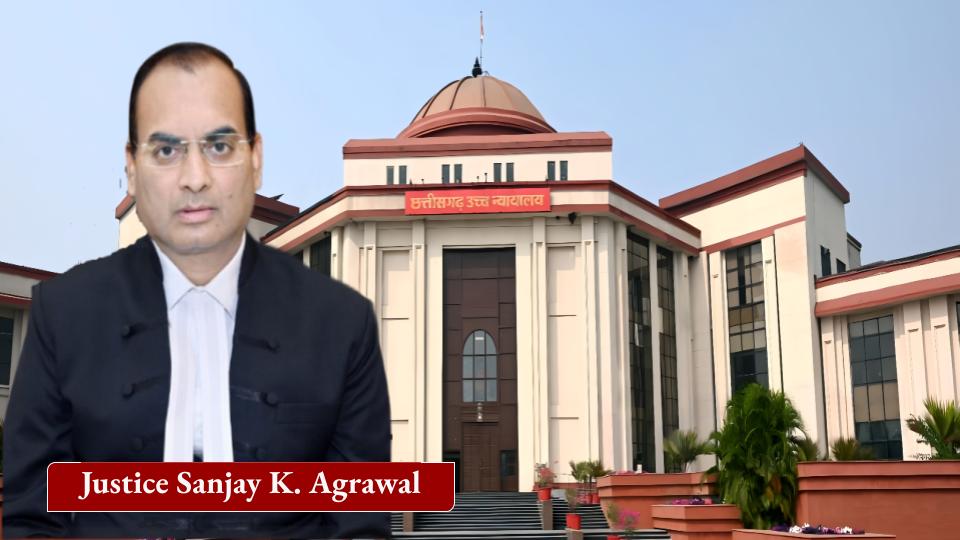
Justice Sanjay K. Agrawal passed the order in WPC No. 226 of 2020, titled Smt. Umadevi Agrawal vs State of Chhattisgarh and Others, on May 15, 2026. The petition challenged an order of the Board of Revenue dated October 23, 2019, which had upheld the Collector’s decision revoking diversion permission granted in favour of the petitioner.
According to the case records, the petitioner had applied for diversion of her land on October 1, 2015. However, before the diversion permission was formally granted, the land was notified for acquisition on November 30, 2015 under Section 20A of the Railways Act, 1989. Despite the acquisition notification, authorities later issued a diversion order in favour of the petitioner on March 31, 2016.
The Collector subsequently reviewed the matter and revoked the diversion order after finding that the land had already been earmarked for railway acquisition. The petitioner’s appeal before the Commissioner, Bilaspur Division, and revision before the Board of Revenue were both dismissed, following which the matter reached the High Court under Article 226 of the Constitution of India.
Appearing for the petitioner, counsel argued that the diversion application had been submitted before the acquisition notification was issued. It was contended that since the application predated the railway notification, the authorities were not justified in cancelling the diversion permission.
The State opposed the plea by relying on Rule 14 of the Chhattisgarh Diversion of Land Rules, 1962, framed under Section 172 of the Chhattisgarh Land Revenue Code, 1959. The government argued that the rule expressly bars diversion of land that is under acquisition proceedings or falls within restricted limits relating to railway lines and highways.
While examining the dispute, the High Court referred to Rule 14(1) and Rule 14(2) of the 1962 Rules, which prohibit diversion of land under acquisition and land situated within the boundary limits of railway lines, national highways, state highways, or other government-maintained roads.
The court observed that the purpose of the restriction is to prevent incompatible land use once acquisition proceedings have commenced for public infrastructure projects. Justice Agrawal held that although the acquisition in the present case was under the Railways Act, 1989 and not under the Land Acquisition Act, the legal principle behind Rule 14 would equally apply.
The court stated, “By virtue of Rule 14, drawing analogy that the land is under acquisition under the Railways Act, 1989, no permission can be granted for diversion of the subject land.”
The High Court further held that the Collector had rightly revoked the diversion order because the earlier permission was granted “ignoring the notification dated 30-11-2015 published under Section 20A of the Railways Act, 1989.”
Dismissing the petition, the court concluded that there was no legal infirmity in the orders passed by the revenue authorities and the Board of Revenue. “I do not find any merit in this writ petition, it deserves to be and is accordingly dismissed,” the court said.
The ruling is significant for landowners and developers dealing with diversion permissions in areas affected by public infrastructure projects. The judgment reinforces that once land acquisition notifications are issued for railway or similar public projects, subsequent diversion permissions may not survive judicial scrutiny even if the original application was filed earlier. The decision also clarifies the broad applicability of Rule 14 of the Chhattisgarh Diversion of Land Rules, 1962 in protecting land reserved for public purposes from conflicting land-use changes.
Case Reference : WPC No. 226 of 2020, Umadevi Agrawal vs State of Chhattisgarh and Others. Counsels for the Petitioner: Mr. Abhishek Khandelwal, Advocate, on behalf of Mr. Awadh Tripathi, Advocate; for the Respondents: Mr. Rahul Tamaskar, Government Advocate.