News Citation : 2026 LN (HC) 369
June 15, 2026 : In a significant ruling clarifying the distinction between attempted murder and grievous hurt under the Indian Penal Code (IPC), the Chhattisgarh High Court has set aside the conviction of four men under Section 307 IPC (attempt to murder) in a 23-year-old assault case. While upholding their involvement in the attack, the Court altered their conviction to Section 326 IPC for causing grievous hurt with dangerous weapons and reduced their sentence to four months’ rigorous imprisonment.
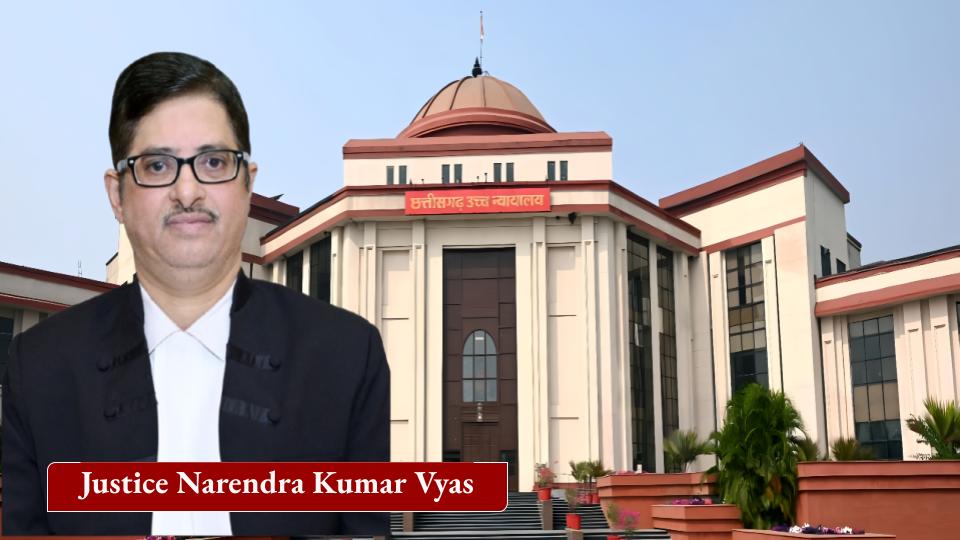
The judgment was delivered by Justice Narendra Kumar Vyas in Criminal Appeal No. 204 of 2005, challenging a March 2005 decision of the Fourth Additional Sessions Judge (Fast Track Court), Raigarh. The trial court had convicted Guru Prasad Patel, Tosh Ram Patel, Tek Ram Patel, and Santosh Patel under Sections 307, 325, and 323 read with Section 34 IPC and sentenced them to seven years’ rigorous imprisonment.
According to the prosecution, the dispute arose in December 2003 over payment for paddy sold by the complainant’s family to one of the accused. The disagreement regarding the agreed price led villagers to convene a Panchayat meeting. During the gathering, tensions escalated and a violent clash broke out. The prosecution alleged that Tosh Ram attacked the victims with a tangiya (axe), while the other accused assaulted them with lathis.
The incident resulted in serious injuries to Upendra Kumar and Tekram alias Puran. Medical evidence showed that Upendra suffered a fracture of the ulna bone in his forearm, while Tekram sustained a hairline fracture of the left parietal bone of the skull. Other injured persons, including Jeetram and Balmukund, suffered simple injuries. Medical reports and witness testimonies formed the foundation of the prosecution’s case.
Before the High Court, the appellants argued that the prosecution had failed to establish the essential ingredients of attempted murder. They contended that the medical evidence did not suggest that the injuries were sufficient to cause death and that the prosecution had not proved any intention or knowledge necessary to attract Section 307 IPC. The defence further pointed out that the incident occurred during a sudden altercation and that there were contradictions in the prosecution’s evidence.
After examining the evidence, the High Court agreed that the prosecution had failed to establish the crucial element of mens rea required for a conviction under Section 307 IPC. The Court noted that the treating doctor had specifically admitted that the injuries sustained by the victims were not sufficient to cause death and that no opinion had been sought regarding the likelihood of death resulting from those injuries. The Court also observed that the evidence suggested a sudden fight triggered by the Panchayat meeting and not a pre-planned attack aimed at killing the victims.
Referring to recent Supreme Court precedents on Section 307 IPC, the High Court emphasized that the nature of injuries alone is not decisive. The prosecution must establish that the accused acted with the intention or knowledge that, had death occurred, the act would amount to murder. The Court observed that, in the present case, the prosecution had failed to prove such intention beyond reasonable doubt. It held that “the prosecution is unable to prove all the ingredients of offence under Section 307 IPC beyond reasonable doubt.”
However, the Court found no reason to doubt the testimony of the injured witnesses. Relying on settled principles regarding the evidentiary value of injured eyewitnesses, the Court held that their accounts were credible and sufficiently corroborated by medical evidence. It concluded that the accused had indeed caused grievous injuries to two victims and simple injuries to the others.
The Court noted that under Section 320 IPC, a fracture constitutes “grievous hurt.” Since the evidence clearly established fractures suffered by the victims, the accused were held liable under Section 326 IPC, which deals with voluntarily causing grievous hurt by dangerous weapons or means. Accordingly, the convictions under Sections 307 and 307/34 IPC were set aside and converted to convictions under Sections 326 and 326/34 IPC.
Another important development in the case was a compromise reached between the accused and the victims during the pendency of the appeal. The victims filed affidavits stating that the dispute had been amicably settled and that cordial relations had been restored between the parties. Based on the compromise, the Court permitted compounding of offences under Sections 325/34 and 323/34 IPC and discharged the accused from those offences.
While determining the appropriate sentence under Section 326 IPC, the High Court considered several mitigating factors. The Court noted that the incident occurred in 2003, more than 23 years had passed, the appellants had no prior criminal antecedents, and they had not misused the liberty granted during the trial and appeal. The settlement between the parties was also taken into account.
Balancing these considerations, the Court sentenced each appellant to four months’ rigorous imprisonment under Sections 326 and 326/34 IPC, with all sentences to run concurrently. The appellants were directed to surrender before the trial court within two months and were granted the benefit of set-off for the period already spent in custody under Section 428 CrPC and the corresponding provisions of the Bharatiya Nagarik Suraksha Sanhita (BNSS).
The ruling is significant because it reiterates that a conviction for attempt to murder cannot rest solely on the seriousness of injuries. Courts must carefully assess the accused’s intention, surrounding circumstances, nature of weapons used, and overall conduct before invoking Section 307 IPC. The judgment also reflects the judiciary’s willingness to consider compromise, passage of time, and rehabilitation while determining an appropriate sentence in long-pending criminal cases.
Case Reference: Guru Prasad & Others v. State of Chhattisgarh, Criminal Appeal No. 204 of 2005.