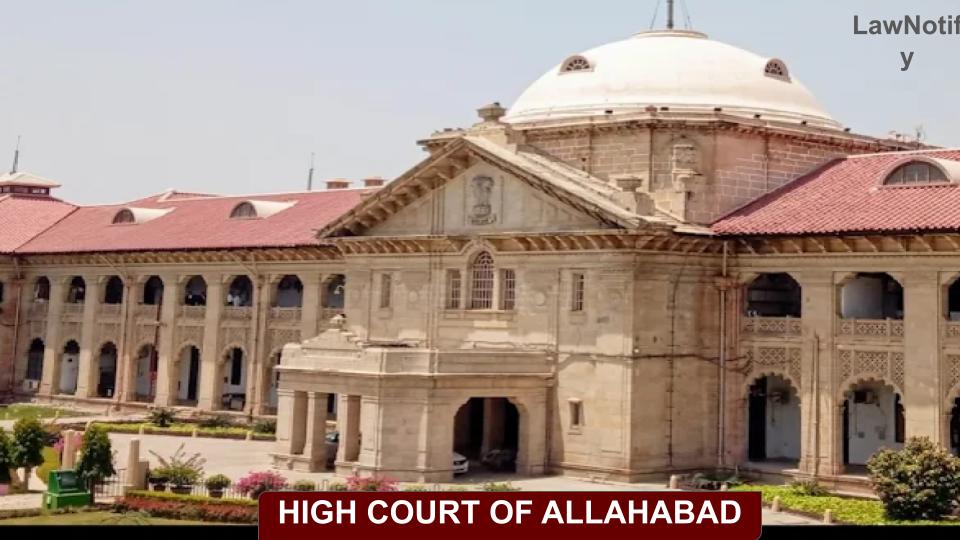
May 11, 2026 : The Allahabad High Court has observed that judicial officers in Uttar Pradesh are functioning under increasing institutional pressure due to shortage of staff, inadequate police cooperation, defective investigation practices and delays in forensic science reports, all of which adversely affect the disposal of criminal cases.
In an order dated May 7, Justice Arun Kumar Singh Deshwal noted that delays in criminal trials cannot be attributed solely to judicial officers. Referring to the popular dialogue from the film Damini, often associated with delay in the justice delivery system, the Court clarified that judges cannot independently ensure speedy trials without adequate administrative and investigative support.
The Court observed that effective adjudication of criminal cases depends upon sufficient ministerial staff, proper execution of summons and warrants by the police, timely production of accused persons and witnesses, and prompt forensic reports from forensic science laboratories. It held that systemic deficiencies in investigation and administrative functioning substantially contribute to pendency in criminal trials.
The Bench also expressed concern regarding the security of judicial officers in the State. It noted that judges are sometimes subjected to direct threats during court proceedings and indirect intimidation outside court premises, especially after passing adverse orders or convictions. According to the Court, such circumstances affect the confidence and independence with which judicial officers discharge their duties, particularly in cases involving habitual offenders.
Drawing a comparison with Punjab and Haryana, the Court noted that judicial officers in those States are provided personal security officers, whereas in Uttar Pradesh such protection is generally restricted to senior judicial posts including District Judges, Chief Judicial Magistrates and certain Additional District Judges. The Court suggested that the State government consider extending similar security arrangements to all district-level judicial officers.
The Bench further observed that an independent and efficient judiciary requires adequate infrastructure, staffing and cooperation from investigative agencies. It stated that dependence on executive authorities for basic operational support adversely impacts the efficiency of the criminal justice system.
The Court remarked that many young judicial officers join the judiciary with the objective of delivering timely justice but face operational difficulties such as inadequate staff strength, delays in service of process, poor investigations and incomplete forensic reports, resulting in institutional frustration.
On the broader systemic impact, the Court observed that delays in criminal trials may allow repeat offenders to continue operating with reduced deterrence and, in certain cases, even enter public life. Referring to data including a report by the Association for Democratic Reforms, the Court noted that a significant number of elected representatives in Uttar Pradesh are facing criminal cases, including serious offences. It stressed that strengthening trial efficiency through better staffing, improved police-judiciary coordination and timely forensic support would lead to more effective criminal justice outcomes for both victims and accused persons.
The observations were made while hearing a bail application in a murder case, where the Court also examined lapses in forensic investigation and police handling of evidence.
Earlier, on April 29, the High Court had summoned senior State officials, including the Director General of Police, the Home Secretary and the Director of the Forensic Science Laboratory, regarding systemic deficiencies affecting criminal trials.
After interacting with the officials, the Court identified multiple structural shortcomings in the functioning of district courts and investigating agencies. It observed that district police officers were not regularly attending monthly monitoring meetings chaired by District Judges and directed that such attendance be made mandatory to improve coordination in criminal justice administration.
The Bench also directed consideration of upgrading the Uttar Pradesh Forensic Science Laboratory into an autonomous body under the Home Department, filling vacancies in forensic units within a fixed timeframe, and enhancing training of police personnel in forensic evidence collection.
Further directions included ensuring proper DNA matching requests are made by investigating officers, recording verified digital contact details of accused persons and witnesses in charge sheets, and adopting technology-driven measures such as speech-to-text tools for recording witness statements under the Bharatiya Nagarik Suraksha Sanhita framework.
The Court additionally stressed strict compliance with electronic criminal procedure systems, including e-summons, e-warrants, e-FIRs and e-charge sheets, and encouraged judicial officers to fully adopt digital processes introduced under the BNSS and related e-process rules to improve efficiency in court administration.