News Citation : 2026 LN (HC) 254 | 2026:CGHC:17176
The Chhattisgarh High Court has dismissed a batch of writ petitions challenging the recruitment process conducted by the Family Court in Durg, holding that minor procedural changes do not invalidate a selection unless actual prejudice is shown. The Court also emphasized that candidates who participate in a selection process without objection cannot later challenge it after being unsuccessful.
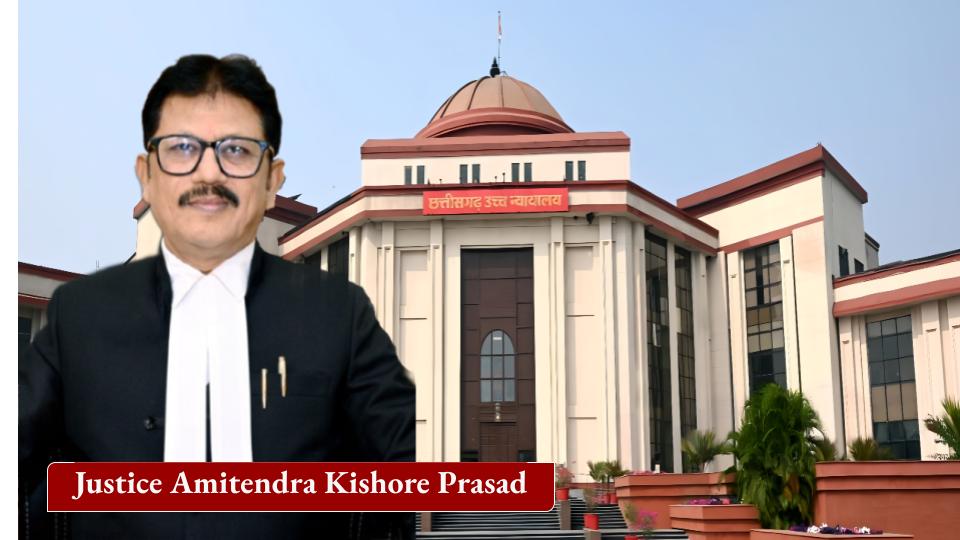
The decision, delivered on April 15, 2026 by Justice Amitendra Kishore Prasad, arose from three connected petitions (WPS Nos. 1363, 2468, and 2505 of 2023). The petitioners had sought cancellation of an advertisement dated June 16, 2022, and the resulting selection and waiting lists published on March 14, 2023, for posts including Stenographer (Hindi) and Assistant Grade-III.
The petitioners alleged multiple irregularities in the recruitment process. Their primary objections included the reconstitution of the selection committee shortly before the written examination, deviation from the advertised exam pattern by reducing the number of questions, absence of a model answer key, and failure to disclose category-wise results. They argued that these factors rendered the process arbitrary and violative of established recruitment norms.
The Court, however, found no merit in these claims. It noted that while the number of questions in the written test was reduced from 50 to 25, the total marks remained unchanged at 100, with proportionately higher marks assigned per question. Importantly, this modification was applied uniformly to all candidates. The Court held that such an administrative adjustment, made in light of the large number of applicants (approximately 3,775), did not cause any demonstrable prejudice.
Reiterating settled legal principles, the Court observed that not every procedural irregularity vitiates a recruitment process. Judicial interference is warranted only when illegality, mala fide intent, or substantial prejudice affecting fairness is established. In this case, the petitioners failed to show that the changes impacted their chances or compromised the integrity of the selection.
A key factor in the dismissal was the conduct of the petitioners themselves. The Court highlighted that they had participated in the selection process without raising any objections at the relevant stage. Relying on established Supreme Court precedents, it held that candidates cannot challenge a process after taking part in it and failing to succeed, as such conduct attracts the doctrines of waiver and estoppel.
The Court also found the petitions to be fundamentally defective due to non-joinder of necessary parties. The selected candidates, whose appointments would be directly affected by any adverse order, were not impleaded. The Court held that no relief could be granted in their absence, as it would violate principles of natural justice.
Further, the Court clarified that the written examination was only a screening stage meant to shortlist candidates for the skill test, which was the decisive phase of the selection. Therefore, objections regarding answer keys or category-wise results at the preliminary stage were not legally significant.
Concluding that there was no illegality, arbitrariness, or violation of statutory rules, the Court dismissed all three petitions, affirming the validity of the recruitment process.
Case Reference : WPS No. 1363 of 2023 (Khushbu Devangan vs Principal Judge, Family Court and Another); WPS No. 2468 of 2023 (Jitendra Kumar Sinha vs Principal Judge, Family Court and Another); WPS No. 2505 of 2023 (Pramod Manikpuri vs Principal Judge, Family Court and Another); Counsels: For Petitioners – Mr. Parth Kumar Jha, Advocate (on behalf of Mr. Tarendra Kumar Jha, Advocate); For Respondent No.1 (in WPS No.1363/2023) – Mr. Aniket Verma, Advocate (on behalf of Mr. Jitendra Pali, Advocate); For Respondent No.1 (in WPS Nos.2468/2023 and 2505/2023) – Mr. Anurag Dayal Shrivastava, Advocate; For State/Respondent No.2 – Mr. Arpit Agrawal, Panel Lawyer.