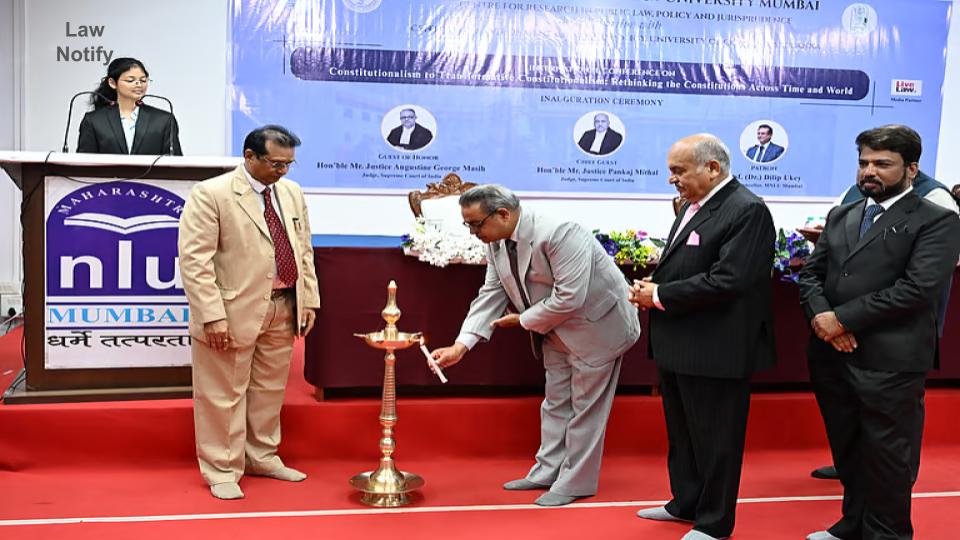
April 26, 2026 : Maharashtra National Law University Mumbai hosted a two-day International Conference on the theme “Constitutionalism to Transformative Constitutionalism: Rethinking the Constitutions across Time and World” from April 18–19, 2026.
The conference was organised by the Centre for Research in Public Law, Policy and Jurisprudence (CRPLPJ), MNLU Mumbai, in collaboration with the Centre for Environmental Law and Policy, University of Colombo.
The inaugural session brought together several distinguished speakers. Registrar Prof (Dr) Prakash Chaudhary delivered the welcome address, outlining the objectives of the conference. The keynote address was given by Prof (Dr) Kokila Konasinghe, Head of the Department of Public and International Law at the University of Colombo, who focused on comparative perspectives of transformative constitutionalism, particularly in India, Sri Lanka, and South Africa.
Vice-Chancellor Prof (Dr) Dilip Ukey, in his presidential address, discussed the evolution of constitutional frameworks across jurisdictions in response to changing socio-political dynamics.
Justice Augustine George Masih, Supreme Court of India, attended as Guest of Honour and highlighted constitutionalism as a safeguard against arbitrary power, while also emphasising the importance of fundamental duties alongside rights.
The Chief Guest, Justice Pankaj Mithal, drew parallels between the ancient concept of Dharma and the modern Constitution, noting that constitutional principles embody duty, rule of law, and protection of citizens.
The inaugural session concluded with a vote of thanks by Dr Pratapsinh Salunke, Officer on Special Duty to the Vice-Chancellor and Associate Dean (Academics). The conference was convened by Dr Sampada Kangane, Director of CRPLPJ, along with Dr Sayalee Surjuse, Assistant Professor and member of CRPLPJ.
The conference received 228 abstracts, with around 172 presenters participating. Technical sessions were evaluated by experts from India, Sri Lanka, and Nepal, ensuring rigorous academic engagement.
Presentations covered a broad range of themes including comparative constitutionalism, judicial review, environmental constitutionalism, and the role of courts in enabling transformative change. The second day featured parallel technical sessions, offering a platform for scholars and practitioners to present their work and engage in detailed discussions with peers and experts.