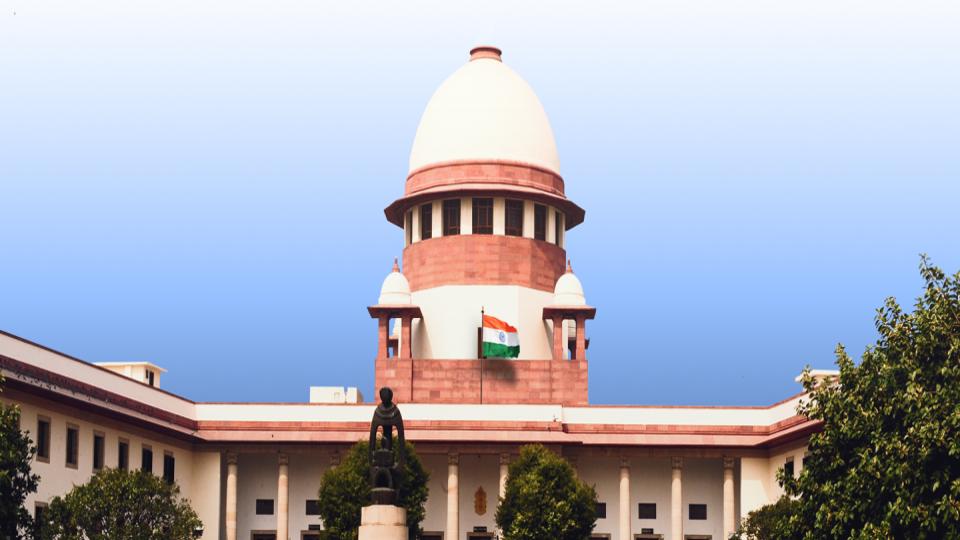
May 22, 2026 : The Supreme Court on Friday referred to a larger bench the contentious issue concerning the grant of bail under the Unlawful Activities (Prevention) Act (UAPA), seeking authoritative clarity on the scope and application of the landmark judgment in K.A. Najeeb Judgment in cases involving prolonged incarceration and delayed trials.
At the same time, the Court granted interim bail for six months to Tasleem Ahmed and Khalid Saifi in the Delhi riots larger conspiracy case, subject to stringent conditions, including a complete prohibition on interacting with the media or making any public statements concerning the pending proceedings.
The order was passed by a bench comprising Justice Aravind Kumar and Justice P.B. Varale while hearing the bail pleas filed by Ahmed and Saifi.
The reference came against the backdrop of the recent judgment in Syed Iftikhar Andrabi v. National Investigation Agency delivered earlier this week by a bench of Justice B.V. Nagarathna and Justice Ujjal Bhuyan. In that decision, the Court had expressed reservations about earlier rulings in the Gulfisha Fatima and Gurwinder Singh cases authored by Justice Aravind Kumar, observing that those judgments appeared to adopt a comparatively restrictive approach to bail under the UAPA and were arguably inconsistent with the principles laid down in K.A. Najeeb.
However, in Friday’s reference order, the bench clarified that the K.A. Najeeb ruling did not establish an inflexible or mechanical formula mandating bail solely on account of delay in trial. The Court observed that the Gulfisha Fatima judgment had treated K.A. Najeeb as a constitutional safeguard requiring a nuanced and individualised assessment of the role attributed to each accused, rather than creating an automatic entitlement to bail merely because of prolonged detention.
The bench noted that in the Gulfisha Fatima case, bail had been granted to five accused persons while being denied to Umar Khalid and Sharjeel Imam after a detailed evaluation of their respective roles. It further observed that Ahmed and Saifi themselves had relied upon the Gulfisha Fatima ruling in support of their present pleas, demonstrating that the judgment did not dilute the principles laid down in K.A. Najeeb.
Justice Aravind Kumar observed that differences of opinion between coordinate benches are neither unusual nor undesirable in the development of jurisprudence. At the same time, he stressed that judicial discipline requires such disagreements to be resolved through a formal reference to a larger bench instead of coordinate benches making critical observations on judgments delivered by benches of equal strength.
The Court underscored that institutional stability and judicial integrity depend upon adherence to established principles of precedent and hierarchy. It held that where a coordinate bench entertains doubts regarding another coordinate bench’s interpretation of a binding larger bench decision, the proper course would be to refer the issue to the Chief Justice of India for constitution of an appropriate larger bench.
The bench also cautioned against adopting absolutist positions while dealing with bail under anti-terror legislation. It observed that treating prolonged incarceration alone as an automatic ground for bail in serious offences affecting national security could undermine legitimate security concerns. Simultaneously, the Court warned that a rigid and mechanical application of the statutory embargo under Section 43D(5) of the UAPA, without due regard to constitutional protections under Article 21, could result in serious infringement of personal liberty.
Holding that authoritative clarification was necessary to ensure consistency and doctrinal coherence in the application of K.A. Najeeb, the bench directed that the matter be placed before the Chief Justice of India for constitution of a larger bench to settle the law governing bail under the UAPA.
During the hearing, Additional Solicitor General S.V. Raju, appearing for the Delhi Police, argued that the Andrabi ruling did not correctly state the law governing bail under statutes containing stringent twin conditions for release. He contended that prolonged incarceration alone could not be sufficient ground for granting bail under the UAPA.
In Andrabi, however, Justice Ujjal Bhuyan had reiterated that the principle of “bail is the rule” continues to apply even in UAPA cases. The judgment also emphasised that benches of lesser or equal strength remain bound by decisions of larger benches unless the matter is formally referred for reconsideration.