News Citation : 2026 LN (HC) 65 | 2026:CGHC:4150-DB
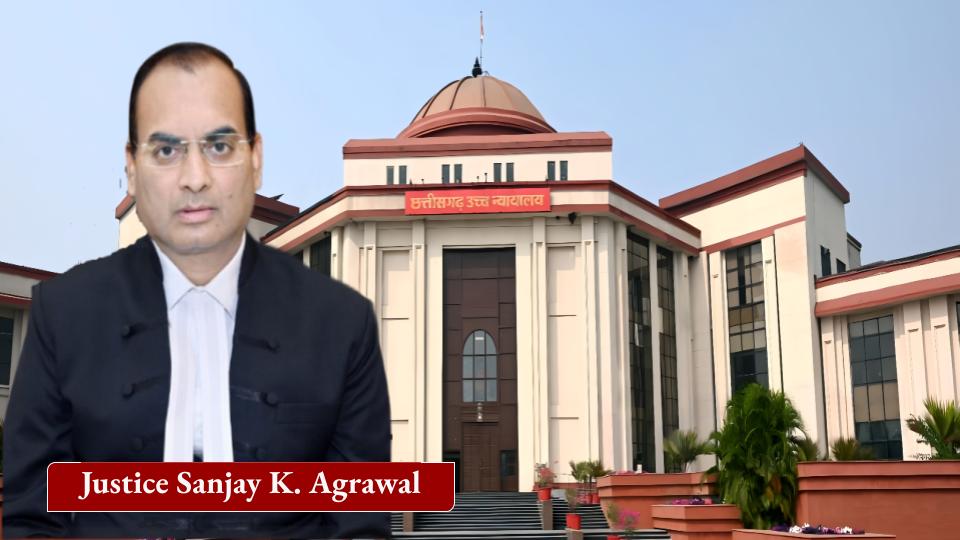
Bilaspur, January 23, 2026 : The High Court of Chhattisgarh at Bilaspur has set aside a 2019 trial court decree granting specific performance of a land sale agreement, holding that the lower court failed to decide a mandatory objection relating to insufficient stamp duty before relying on the agreement.
A Division Bench of Justice Rajani Dubey and Justice Amitendra Kishore Prasad allowed a first appeal filed by Chhedan Prasad Sharma, remanding the matter to the trial court for fresh adjudication after deciding the admissibility of the disputed agreement in accordance with the Indian Stamp Act.
The case arose from a civil suit filed by Vinod Agrawal seeking specific performance of an agreement dated December 31, 2012, under which Sharma had allegedly agreed to sell agricultural land in village Ghughwa, Durg district. Agrawal claimed he paid an advance of ₹2.5 lakh and was always ready and willing to complete the transaction, while Sharma deliberately avoided completing formalities.
The trial court had decreed the suit in Agrawal’s favour in March 2019, directing execution of the sale deed. Sharma challenged the decree before the High Court, arguing that the agreement relied upon by the plaintiff was insufficiently stamped and therefore inadmissible in evidence. He pointed out that a specific objection to admissibility had been raised when the document was tendered during trial, and that the court had explicitly deferred its decision on that objection.
The High Court found merit in this contention. It noted that although the trial court recorded that the objection regarding stamp duty would be decided at the time of final judgment, it ultimately failed to adjudicate the issue and nonetheless relied upon the agreement as the foundation for granting relief.
Relying on settled Supreme Court precedent, the Bench held that Sections 33 and 35 of the Indian Stamp Act impose a mandatory duty on courts to examine whether an instrument is duly stamped before admitting it in evidence. A document that is chargeable with stamp duty cannot be relied upon for any purpose unless the deficit duty and penalty are paid in accordance with law.
The Court rejected the argument that the defendant’s admission of execution cured the defect. It clarified that admission of execution does not override the statutory bar created by insufficient stamping, which goes to the very competence of the court to act upon the document.
Holding that the agreement formed the very basis of the claim for specific performance, the Bench ruled that deciding the suit without first determining its admissibility amounted to a material irregularity in the exercise of jurisdiction.
Accordingly, the High Court set aside the judgment and decree dated March 7, 2019, and remanded the matter to the trial court. The trial court has been directed to first adjudicate the stamp duty objection, pass appropriate orders under the Stamp Act, and only thereafter reconsider the suit on merits. The parties have also been granted liberty to amend pleadings and lead additional evidence. They have been directed to appear before the trial court on February 3, 2026.