News Citation : 2026 LN (HC) 387
June 18, 2026 : the Chhattisgarh High Court has held that there is no mandatory legal requirement under Section 165(6) of the Chhattisgarh Land Revenue Code, 1959, that a tribal landholder must retain at least five acres of irrigated land or ten acres of unirrigated land before permission for sale of land can be granted. The Court observed that revenue authorities had misinterpreted the law while rejecting a tribal farmer’s application to sell a small portion of his land.
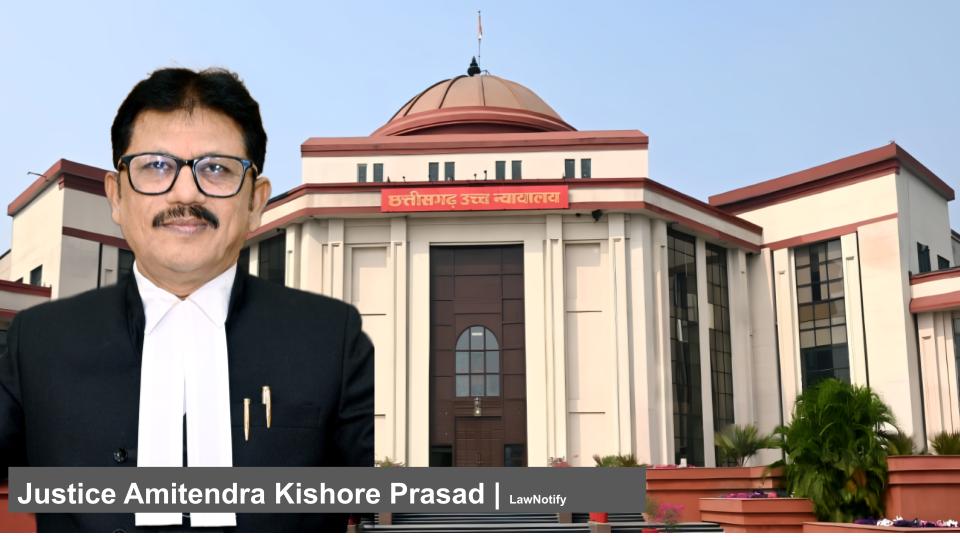
Justice Amitendra Kishore Prasad delivered the judgment in Vijay v. State of Chhattisgarh & Others on June 18, 2026, allowing a writ petition filed by Vijay, a resident of Mungeli district belonging to the Scheduled Tribe community. The petitioner had challenged the orders of the Collector, Mungeli, and the Chhattisgarh Board of Revenue, Bilaspur, which had refused permission for the sale of a portion of his land.
According to the case records, the petitioner sought permission to sell a small part of his land situated in Village Raitra Khurd to meet pressing financial obligations, including repayment of debt and family expenses. An agreement to sell had already been executed with the proposed purchaser, and an advance payment had been received. Since the petitioner belonged to a Scheduled Tribe, prior permission of the Collector was required under Section 165(6) of the Chhattisgarh Land Revenue Code.
During the revenue inquiry, the Tehsildar recorded statements of the parties, verified land records, and assessed the petitioner’s remaining landholding. The inquiry concluded that even after the proposed sale, the petitioner would continue to possess approximately 1.246 hectares (around 3.076 acres) of land, which was considered sufficient for his livelihood. The Tehsildar recommended that permission be granted.
However, the Sub-Divisional Officer disagreed with the recommendation and advised rejection of the application, stating that less than five acres of land would remain with the petitioner after the sale. Acting on this recommendation, the Collector rejected the application on March 10, 2022. The Board of Revenue subsequently upheld the Collector’s decision on March 24, 2023.
Before the High Court, the petitioner argued that the authorities had wrongly treated the so-called “five-acre rule” as an absolute legal bar. He contended that Section 165(6) was intended to prevent exploitation of tribal landholders and not to prohibit genuine transactions undertaken to meet legitimate financial and domestic needs. It was further argued that substantial land would remain with him even after the proposed sale and that the transaction was voluntary, fair, and free from any element of exploitation.
The State defended the orders, contending that the restrictions under Section 165(6) are protective measures designed to safeguard tribal communities from land alienation and economic marginalization. According to the State, maintaining a minimum landholding was a reasonable administrative standard to prevent distress sales and fragmentation of tribal land.
After examining the statutory provisions, the High Court found that the authorities had confused the requirements of Section 165(6) with those contained in Section 165(7) of the Code. The Court explained that Section 165(6) governs voluntary transfers of tribal land to non-tribals with prior permission of the Collector, whereas Section 165(7) deals with attachment and sale of land in execution proceedings arising from decrees or orders of courts. The minimum landholding requirement relied upon by the authorities applies only in execution proceedings and cannot be imported into cases involving voluntary transfers under Section 165(6).
The Court observed, “A plain reading of Section 165(6) of the Code, 1959 nowhere prescribes any mandatory condition that a tribal bhumiswami must retain minimum 5 acres of irrigated land or 10 acres of unirrigated land before permission for transfer can be granted.” It further held that the Collector and the Board of Revenue had incorrectly interpreted the statutory provisions and mechanically rejected the application on an erroneous legal basis.
The Court also noted that the petitioner’s request was based on bona fide financial necessity and that the inquiry conducted by the Tehsildar had found no evidence of fraud, coercion, or exploitation. Significantly, the proposed sale involved only a small portion of land, while substantial land would continue to remain with the petitioner. The Court emphasized that protective provisions intended for tribal welfare should not be interpreted so rigidly that they defeat genuine livelihood and domestic needs.
Referring to the Supreme Court’s decision in State of Madhya Pradesh v. Dinesh Kumar & Others (2025 SCC OnLine SC 754), the High Court reiterated that the Collector must exercise discretion based on relevant statutory considerations and recorded reasons rather than on conditions not found in the law.
Consequently, the High Court quashed both the Collector’s order dated March 10, 2022, and the Board of Revenue’s order dated March 24, 2023. The matter has been remanded to the competent authority for fresh consideration. The Court directed the authority to re-examine the petitioner’s application by taking into account his genuine financial need, the extent of remaining land available for sustenance, the fairness of the transaction, and the true scope of Section 165(6) of the Code. A fresh reasoned decision has been ordered to be passed within three months.
The ruling is expected to have wider implications for tribal land transfer cases across Chhattisgarh, as it clarifies that revenue authorities cannot impose conditions that are not expressly provided under the statute and must evaluate each application on its individual facts and merits.
Case Reference : Vijay v. State of Chhattisgarh & Others, WPC No. 2351 of 2023, decided on June 18, 2026, High Court of Chhattisgarh.