News Citation : 2026 LN (HC) 388
June 18, 2026 : In a significant ruling on the scope of the Right to Information Act, 2005, the Chhattisgarh High Court has held that DAV Public School, Korba, operated by the Dayanand Anglo Vedic College Trust and Management Society, cannot be treated as a “public authority” under Section 2(h) of the RTI Act merely because it has a financial arrangement with South Eastern Coalfields Limited (SECL). The Court consequently set aside the orders passed by the Central Information Commission (CIC), including directions requiring disclosure of information and the imposition of a penalty on the school’s Principal.
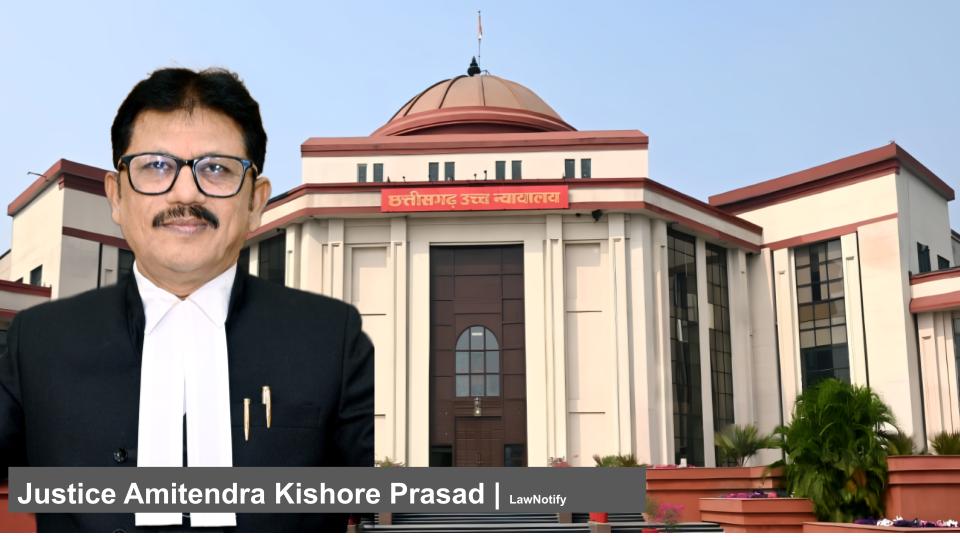
The judgment was delivered by Justice Amitendra Kishore Prasad on June 18, 2026, while deciding a batch of connected writ petitions filed by DAV Public School challenging CIC orders passed in several second appeals arising from RTI applications filed by a former employee’s family member. The petitions questioned the legality of the CIC’s decision to treat the institution as a public authority and its Principal as a “deemed Public Information Officer” under the RTI Act.
The dispute originated after the wife of one of the respondents, who had earlier served in the school on an ad hoc basis, was discontinued from service. Following her removal, RTI applications were filed before the Central Public Information Officer of SECL seeking information relating to the internal administration and service matters of the school. Although the applications were addressed to SECL, the information sought pertained exclusively to the functioning of DAV Public School. The school consistently maintained that it was a private, self-financed educational institution and was therefore outside the ambit of the RTI Act.
According to the school, SECL merely reimbursed the deficit arising from concessional education provided to the children of SECL employees under a memorandum of understanding. The institution argued that this arrangement neither made it government-controlled nor substantially financed by a public authority. The school further contended that it was run by a registered society under the Societies Registration Act, 1860, with its administration, finances, appointments and policies being independently managed by the DAV College Managing Committee, New Delhi.
The Central Information Commission had taken a contrary view and proceeded on the premise that the school was substantially financed by SECL. It treated the Principal as a “deemed Public Information Officer” and imposed a penalty of ₹5,000 for alleged non-compliance with RTI obligations. The school challenged these actions before the High Court.
During the proceedings, even SECL supported the school’s stand and submitted that the institution was neither administratively nor financially controlled by the public sector undertaking. SECL clarified that its role was confined to reimbursing deficits arising from concessional fees and that such payments could not be equated with “substantial financing” within the meaning of Section 2(h) of the RTI Act.
The Court examined the definition of “public authority” under Section 2(h) of the RTI Act and the provisions relating to Public Information Officers under Section 5. It noted that an institution can be brought within the RTI framework only if it is owned, controlled, or substantially financed by the Government or its instrumentalities. The Court also analyzed Supreme Court precedents, including Thalappalam Service Cooperative Bank Ltd. v. State of Kerala, which clarified that “substantial financing” means financial support of such magnitude that the institution becomes practically dependent on that funding for its existence.
Applying these principles, the High Court found that DAV Public School maintained its own financial corpus, generated revenue independently through fees and other permissible sources, and was not dependent on SECL for its survival. The reimbursement arrangement with SECL was described as compensatory and situational rather than foundational to the institution’s functioning. The Court held that such assistance did not satisfy the legal threshold of “substantial financing.”
The Court also rejected the argument that SECL exercised control over the institution merely because some of its representatives were members of the Local Managing Committee. It observed that the ultimate authority over policy decisions, administration, finances and governance remained with the DAV College Managing Committee. The presence of SECL nominees did not amount to the kind of “deep and pervasive control” required under constitutional and RTI jurisprudence.
In a key observation, the Court held that, “the petitioner institution does not fall within the ambit of a ‘public authority’ as defined under Section 2(h) of the RTI Act,” noting that the essential ingredients of ownership, control, or substantial financing by the Government were absent. The Court further observed that “the financial arrangement with SECL, being limited, compensatory, and situational in nature, falls far short of the threshold of ‘substantial financing’.”
Having concluded that the school was not a public authority, the Court ruled that the CIC had no jurisdiction to invoke Section 5 of the RTI Act against it. It emphasized that the concept of a “deemed Public Information Officer” can arise only within the framework of a recognized public authority. Since DAV Public School did not qualify as such, its Principal could not legally be designated or penalized as a deemed PIO. The Court described the CIC’s assumption of jurisdiction as “fundamentally flawed” and “legally unsustainable.”
The ruling reinforces the distinction between private educational institutions and bodies genuinely subject to government ownership, control, or substantial financing. It is expected to have wider implications for RTI proceedings involving private schools and educational societies that receive limited financial assistance or maintain contractual arrangements with government entities. The judgment clarifies that occasional support, reimbursement mechanisms, or representation in management committees, without real financial dependence or administrative control, are insufficient to transform a private institution into a public authority under the RTI Act.
Case Reference : DAV Public School v. Central Information Commission & Others, WPC Nos. 3145/2020, 3365/2020, 65/2021 and 862/2021.