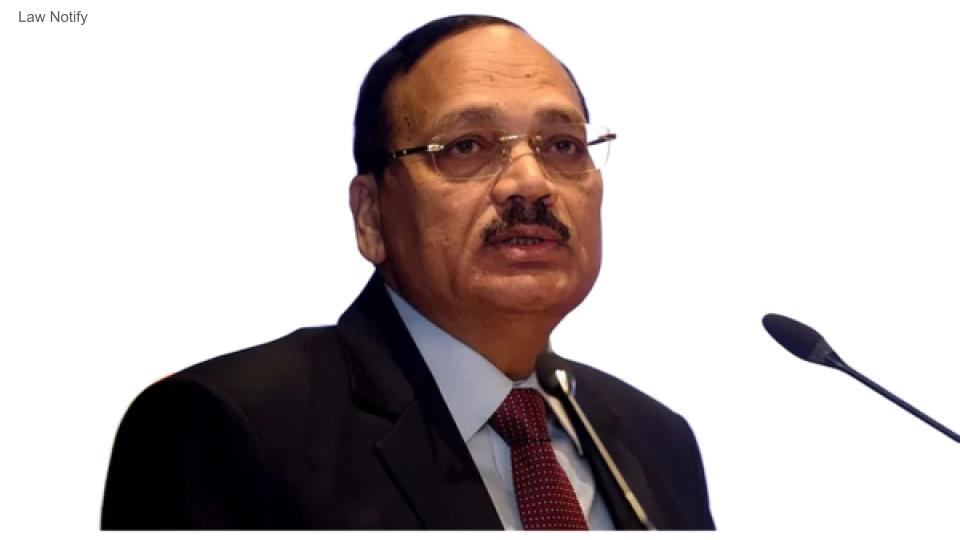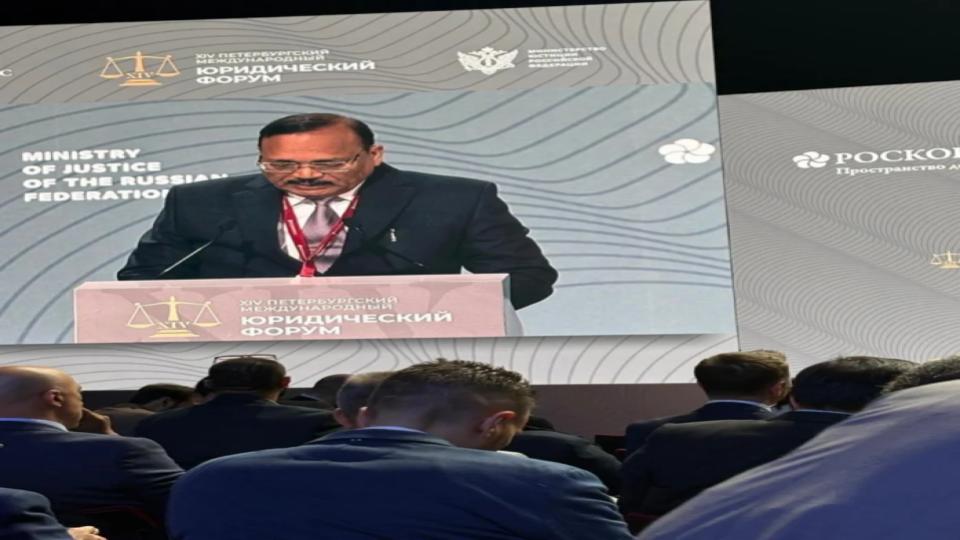
June 25, 2026 : St. Petersburg: Chief Justice of India Surya Kant has asserted that equality is the true foundation of international law and that the legitimacy of the global legal order should be measured not by treaties or institutions alone, but by whether every nation and every individual has equal access to justice. He made these remarks while delivering the plenary address at the XIV St. Petersburg International Legal Forum on the theme “Equal Justice, Equal Law: Access as the Measure of International Law’s Humanity.”
Beginning his address with the Russian greeting “Dobriy Den,” Justice Surya Kant described the forum as one of the world’s leading platforms for serious legal discourse. Drawing inspiration from Russian author Fyodor Dostoevsky, who called St. Petersburg “the most fantastical and intentional town,” the Chief Justice linked the city’s history with the evolution of law.
Using Falconet’s iconic Bronze Horseman as a metaphor, he noted that the monument to Peter the Great stands on the massive Thunder Stone, the largest stone ever moved by humans, because every enduring monument requires a strong foundation. In the same way, he said, international law can remain durable only if it is built upon the principle of equality.
“The foundation of international law is equality,” Justice Surya Kant observed, adding that courts, conventions and international declarations derive their strength only from this fundamental principle.
Tracing the historical roots of equality before the law, the Chief Justice said the idea existed long before the Magna Carta. Referring to Kautilya’s Arthashastra from the 4th century BCE, he noted that a ruler who does not remain subject to dharma and the rule of law ceases to be a legitimate king. He also referred to the Roman concept of lex regia, Islamic Shari’a and the African philosophy of Ubuntu as examples of civilizations that recognized equality before the law as a universal legal principle rather than a privilege granted by those in power.
Justice Surya Kant further highlighted the United Nations Charter’s commitment to the sovereign equality of nations, cautioning that principles such as jus cogens, erga omnes and pacta sunt servanda are fundamental safeguards against arbitrary exercise of international power and cannot be compromised.
Questioning the present state of international law, he remarked that the continuing debate over whether it serves only a privileged few or all sovereign nations equally reflects a serious weakness in the global legal system. According to him, the real measure of international law is whether every sovereign state and every individual can effectively access justice and obtain meaningful legal remedies.
Referring to India’s constitutional journey, the Chief Justice said the country’s judiciary has worked to translate constitutional promises into reality despite geographical, economic, linguistic and cultural challenges. He pointed to reforms such as liberalising rules of legal standing, expanding free legal aid and treating procedural law as an instrument of justice rather than an obstacle.
On the international stage, Justice Surya Kant acknowledged that landmark human rights instruments, including the International Covenant on Civil and Political Rights (ICCPR), the International Covenant on Economic, Social and Cultural Rights (ICESCR), the Convention on the Elimination of All Forms of Discrimination Against Women (CEDAW) and the Convention on the Rights of the Child (CRC), represent significant global achievements. However, he observed that their implementation is often uneven, with countries in the Global East and Global South facing greater scrutiny than wealthier nations despite simultaneously addressing poverty, institution-building and the enduring consequences of colonialism.
Concluding his address, the Chief Justice emphasized that declarations and conventions alone cannot sustain the international legal order. Equal justice and equal law, he said, are not ceremonial ideals but enduring responsibilities that every jurist must protect to preserve the credibility and humanity of international law.
Justice Surya Kant also expressed gratitude to the Russian Federation for hosting the forum. His address came a day after he signed a landmark Memorandum of Understanding on judicial cooperation with the Chairman of the Supreme Court of Russia, Igor Krasnov, in Moscow.