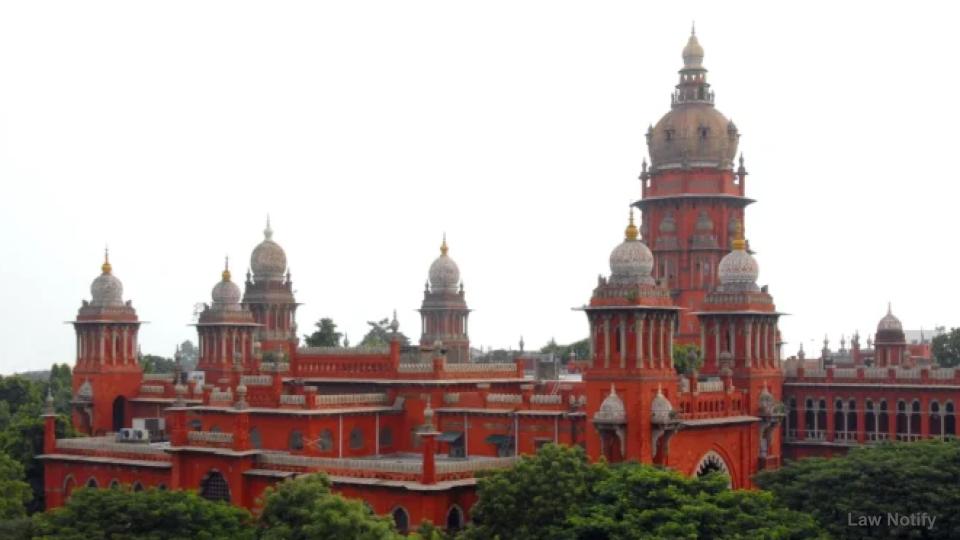
The Madras High Court on Sunday issued notice to the Election Commission of India (ECI) on a petition filed by DMK leader and former Co-operatives Minister KR Periakaruppan, alleging that a postal ballot was wrongly processed between two Assembly constituencies sharing the name Tiruppattur during the 2026 Tamil Nadu Assembly elections.
The dispute relates to the Tiruppattur Assembly constituency, where TVK candidate Seenivasa Sethupathi was declared elected by a margin of just one vote. According to the petitioner, a valid postal ballot intended for one Tiruppattur constituency was mistakenly routed to another constituency with the same name, resulting in the rejection of what could have been a decisive vote.
During a special Sunday sitting, a Division Bench comprising Justice L Victoria Gowri and Justice N Senthil Kumar examined whether electoral laws provide any mechanism to rectify such an inter-constituency postal ballot error. The Court questioned the Election Commission on the remedial procedure available when a postal ballot is delivered to the wrong Returning Officer and later rejected.
Senior counsel appearing for the petitioner argued that neither the Representation of the People Act, 1951 nor the Conduct of Election Rules, 1961 specifically deals with such an unusual situation. It was submitted that while Rule 54A governs scrutiny of postal ballots, it does not address cases involving misrouting between constituencies. The petitioner therefore sought relief under Article 226 of the Constitution, contending that constitutional writ jurisdiction was necessary to ensure electoral justice.
The petitioner further maintained that the issue concerns counting a valid vote in the correct constituency rather than seeking a recount. It was argued that the alleged administrative lapse directly affected the election result due to the razor-thin margin and could potentially invoke statutory provisions relating to tie-breaking under election law.
Counsel for the winning candidate opposed the plea, arguing that the matter effectively challenges the election outcome and can only be adjudicated through an election petition under Article 329(b) of the Constitution. The defence submitted that the Returning Officer becomes functus officio after the declaration of results, and that writ jurisdiction cannot be invoked to reopen election-related adjudication indirectly.
The Election Commission also contended that disputes arising after declaration of results regarding validity or effect of votes should ordinarily be pursued through the election petition mechanism before the appropriate tribunal.
Considering the urgency of the matter, particularly as the declared winner has yet to formally assume office, the High Court sought clarification from the Election Commission on the legal and procedural framework governing correction or redirection of wrongly assigned postal ballots. The matter will be taken up again after the Commission files its response.