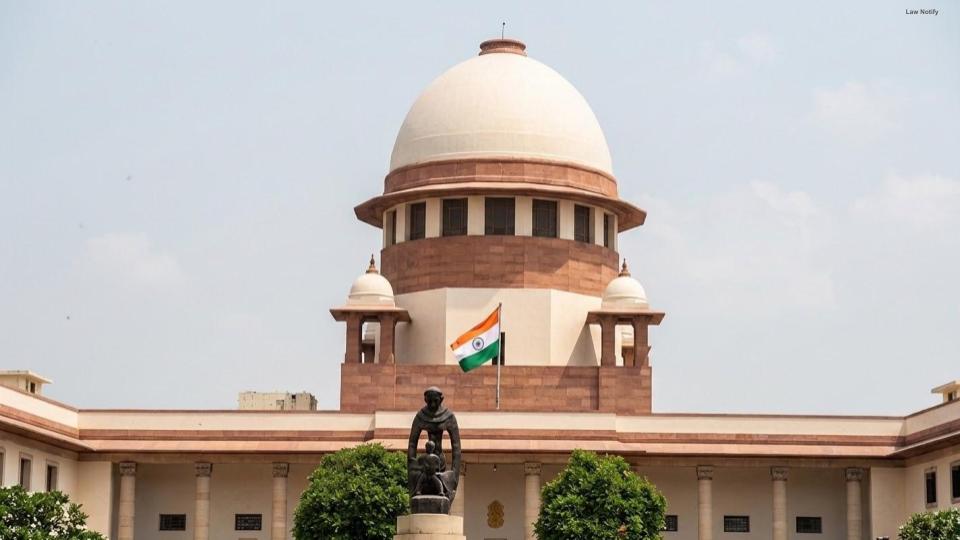
May 11, 2026 : The Supreme Court on Monday declined to issue any further directions in the matter concerning the recent controversy involving an Andhra Pradesh High Court judge and a young advocate, observing that the dispute had already been amicably resolved at the High Court level through the intervention of the Chief Justice and the Bar Association.
A Bench comprising Chief Justice of India Surya Kant and Justice Joymalya Bagchi noted that the incident appeared to have arisen from a misunderstanding during court proceedings and that the oral remarks made by the judge had not resulted in any executable judicial order.
The Court observed that the judge had seemingly formed an impression that the advocate intentionally threw files on the podium in anger, while the advocate clarified that the files had accidentally slipped from his hands.
Taking note that the matter had been settled internally and that the advocate concerned no longer had any grievance, the Bench held that there was no need for further judicial intervention.
At the same time, the Supreme Court made important observations on judicial conduct, courtroom discipline and the need for institutional sensitivity towards young lawyers. The Bench emphasised that judges at all levels must exhibit patience, restraint, compassion and an encouraging approach, especially while dealing with junior advocates and first-generation practitioners.
The Court observed that while senior members of the Bar are expected to guide young lawyers in maintaining professional discipline and ethical standards, the judiciary also carries an equal responsibility to foster professionalism, integrity and respect for the justice delivery system.
Describing advocates as officers of the court, the Bench stated that they must be treated in a manner that preserves their dignity as well as public confidence in judicial institutions.
The Supreme Court also expressed concern over the circulation of selective courtroom video clips on social media and cautioned the media against reporting judicial proceedings without proper context. It observed that truncated or decontextualised clips could create unnecessary prejudice and damage institutional credibility.
The matter was being heard in suo motu proceedings initiated on the basis of representations submitted by the Supreme Court Bar Association (SCBA) and the Bar Council of India (BCI) after a video allegedly showing Andhra Pradesh High Court judge Justice Tarlada Rajasekhar Rao threatening a young advocate with police custody during a hearing went viral.
During the hearing, SCBA President Senior Advocate Vikas Singh suggested that an institutional mechanism should be developed to prevent similar incidents and to ensure protection and encouragement for young advocates entering the profession.
The Supreme Court acknowledged the importance of creating a supportive environment for junior lawyers and observed that sensitisation of judges was equally essential for maintaining healthy Bench-Bar relations.
In its order, the Court appreciated initiatives undertaken by the SCBA for mentoring young advocates and recommended that similar measures be adopted by the Bar Council of India and State Bar Councils across the country.
The Bench further recommended that all High Courts establish Grievance Redressal Committees comprising representatives of Bar Associations and Bar Councils to address disputes between advocates and members of the judiciary. It also suggested that similar committees be constituted at district and taluka levels for timely and amicable resolution of institutional issues affecting courtroom functioning and professional conduct.
The controversy originated from a courtroom exchange on May 5, 2026, during which the Andhra Pradesh High Court judge was seen orally reprimanding a young advocate and directing that police personnel be called. The incident sparked widespread concern within the legal fraternity, prompting Bar bodies to seek intervention on issues relating to judicial restraint, professional dignity and institutional accountability.