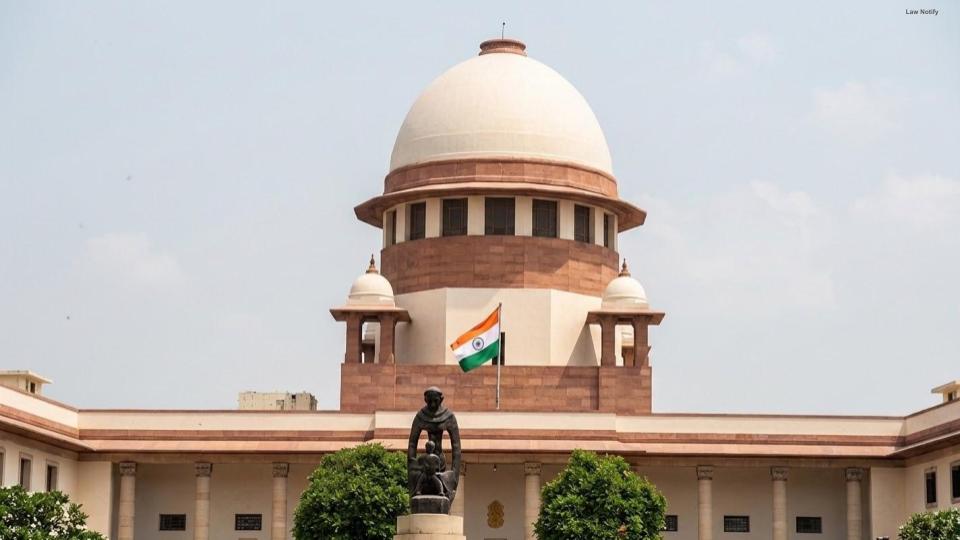
June 11, 2026 : The Supreme Court on Thursday stayed the operation of an Allahabad High Court judgment that had criticised Uttar Pradesh Additional Chief Secretary (Home) Sanjay Prasad for allegedly obstructing the implementation of police reforms in the State and had directed that its observations be considered while assessing his future administrative responsibilities.
A Bench comprising Justice Prashant Kumar Mishra and Justice Atul S. Chandurkar passed the interim order on an application filed by Prasad and stayed the High Court’s directions requiring the Department of Personnel and Training (DoPT) to take note of the findings recorded against the senior IAS officer.
Prasad, a 1995-batch IAS officer and one of the most influential bureaucrats in the Uttar Pradesh administration, had been subjected to adverse observations by the Allahabad High Court in its June 3 judgment delivered by Justice Vinod Diwakar.
The High Court had expressed concern over what it described as persistent administrative resistance to judicially mandated police reforms in Uttar Pradesh. It observed that Prasad’s conduct prima facie appeared to be a deliberate attempt to undermine the authority of the Court and impede measures aimed at improving the quality, fairness and accountability of criminal investigations.
The observations were made during the hearing of a habeas corpus petition filed by a woman seeking custody of her minor daughter, who was allegedly lured away by a man. After finding serious deficiencies in the police investigation and noting the failure of authorities to recover the child, the Court examined whether directions issued in the earlier case of Subhash Chandra & Others v. State of Uttar Pradesh & Another regarding police reforms were being effectively implemented.
When questioned about the alleged non-compliance, the State government informed the Court through an affidavit that it had decided to challenge the Subhash Chandra judgment before the Supreme Court and requested that no further implementation directions be issued.
However, the High Court noted that the May 2025 judgment had remained unchallenged for nearly a year and observed that the decision to approach the Supreme Court was taken only after explanations regarding compliance were sought from Prasad. The Court further recorded that despite being granted time, the State failed to produce any order from the Supreme Court relating to the proposed challenge.
While acknowledging the State’s constitutional right to challenge judicial decisions, the High Court emphasised that such actions should not be influenced by personal considerations of individual officers. It concluded that resistance to police reforms designed to ensure fair and professional investigations was inconsistent with constitutional principles and the rule of law.
Consequently, the High Court directed the Secretary, DoPT, Government of India, to place its observations on record and consider them while evaluating Prasad’s suitability for future public assignments and administrative responsibilities.
The Supreme Court has now stayed the operation of those directions and adverse findings pending further consideration of the matter.