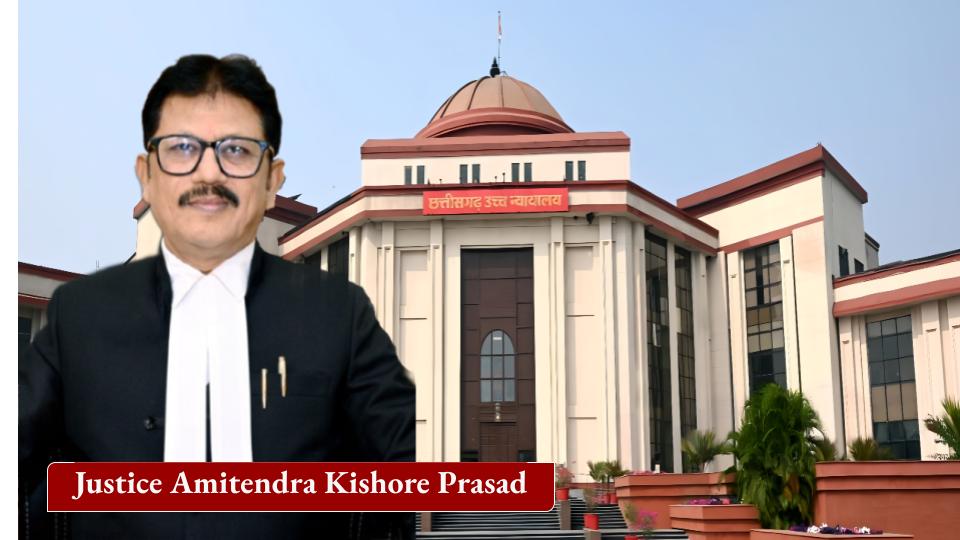
June 2, 2026 : The Chhattisgarh High Court has made it clear that no child can be compelled to recite Hindu prayers in government schools while hearing a petition challenging a state government circular introducing Hindu prayers as part of the daily routine in government educational institutions.
A Single Bench of Justice Amitendra Kishore Prasad was hearing a writ petition challenging the constitutional validity of a circular issued by the Chhattisgarh School Education Department on June 12, 2026. The circular proposed the recitation of Saraswati Vandana, Gayatri Mantra, Guru Mantra, Deep Mantra and other prayers during school assemblies in government schools across the state.
During the hearing, the State government informed the Court that although the circular had been issued in June, it had not yet been implemented in any government school. Recording this submission, the High Court disposed of the petition for the present, while granting liberty to the petitioners to approach the Court again if any student was compelled to participate in the prescribed prayers.
The Court observed that if any instance of coercion or compulsory participation was brought to its notice, appropriate action would be taken. A detailed order in the matter is awaited.
The petition was filed by former Chhattisgarh Waqf Board Chairman Abdul Salam Rizvi, former Minority Department Chairman Mahendra Chhabda and Bilaspur-based social activist Shafique Ahmed. They challenged the government circular directing schools to include the National Anthem, National Song, Deep Mantra, Saraswati Vandana and Guru Mantra during morning assemblies.
The circular also prescribed the reading of biographies of eminent personalities, recitation of the Bhojan Mantra before serving mid-day meals, and chanting of the Gayatri Mantra and Shanti Mantra before students dispersed for the day.
The petitioners argued that the circular violated the constitutional principles of secularism, equality and freedom of conscience guaranteed under the Constitution. According to them, making Saraswati Vandana, Gayatri Mantra, Guru Mantra and Shanti Mantra part of the official school routine amounted to religious instruction and promoted one particular religion in state-funded educational institutions.
They further contended that the circular did not provide any exemption for students belonging to other faiths or for those unwilling to participate in religious observances. The absence of such safeguards, they argued, exposed children to compelled participation in religious practices in violation of their fundamental rights.
The plea also asserted that the State is constitutionally obligated to maintain religious neutrality in public education. By prescribing prayers associated with one religion while excluding others, the circular allegedly undermined the secular character of government schools and amounted to impermissible state endorsement of a particular faith.
However, since the State informed the Court that the circular had not yet been enforced, the High Court declined to examine the constitutional validity of the policy at this stage. At the same time, it unequivocally clarified that no student can be forced to recite Hindu prayers in government schools and permitted the petitioners to revive the proceedings if the circular is implemented in a manner that infringes constitutional rights, freedom of conscience or the secular nature of public education.