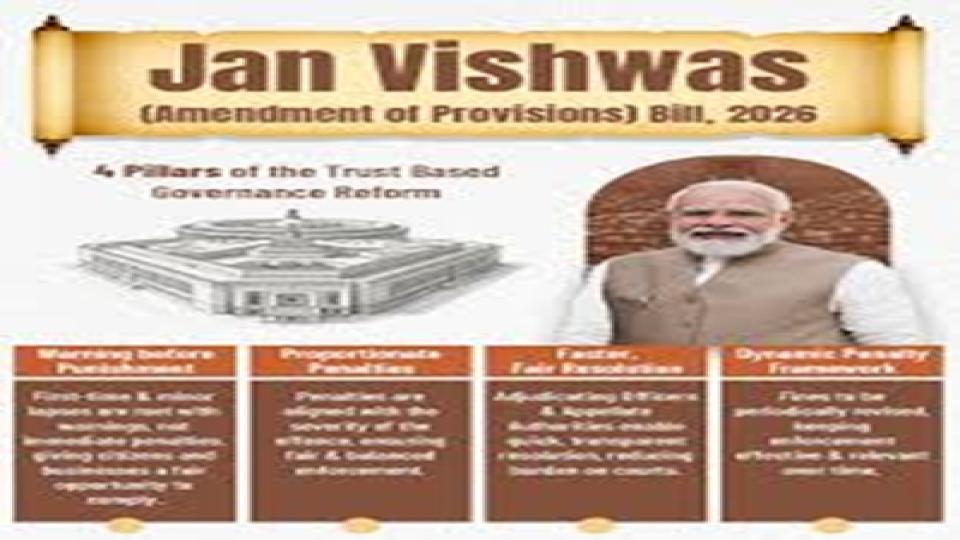
April 1, 2026 : The Lok Sabha has taken up the Jan Vishwas (Amendment of Provisions) Bill, 2026, for consideration and passage. The proposed legislation seeks to amend multiple enactments with the objective of decriminalising minor offences and rationalising penalties, thereby promoting trust-based governance and improving ease of living and doing business.
The Bill proposes amendments to 79 Central Acts administered by 23 Ministries. In total, 784 provisions are set to be revised, of which 717 provisions are proposed to be decriminalised to support ease of doing business, while 67 provisions aim to enhance ease of living. The reforms include substituting criminal penalties with monetary fines and ensuring that penalties are proportionate to the nature of the offence.
Initiating the discussion, Chamala Kiran Kumar Reddy of the Congress criticised the Bill, stating that despite its stated intent, it may lead to increased corruption. He argued that the legislation does not meaningfully strengthen public trust and fails to address underlying structural concerns. He further contended that diluting criminal penalties would not necessarily improve the business environment and alleged that the Bill removes imprisonment provisions for offences such as the manufacture and sale of fake medicines and fraudulent cosmetics.
In response, Tejasvi Surya of the BJP supported the Bill, describing it as a significant reform measure. He characterised it as one of the largest decriminalisation exercises in India’s history, stating that the legislation eliminates criminal liability for a vast number of minor offences. According to him, the Bill represents a broader shift in governance philosophy from a regime of control and distrust to one of facilitation and trust aimed at building a more business-friendly and citizen-centric framework.